A player makes the same pass ten times and looks comfortable. Change the task on the next catch and the preparation disappears. The hands are late. The eyes search. The player needs time to work out what to do.
That is a different coaching problem from the passing motion itself. Repetition can help build the motion. The player also needs practice selecting and preparing it when the next task is uncertain.
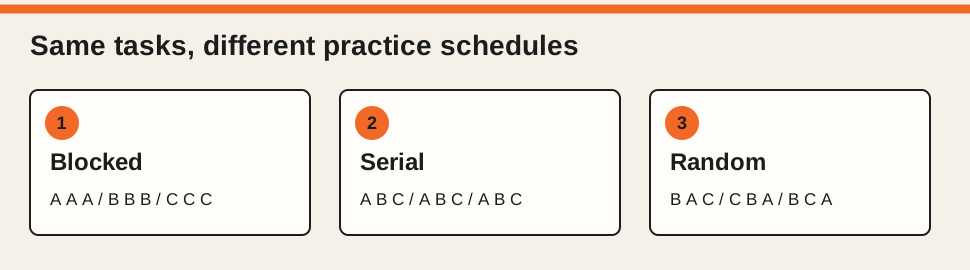
Three ways to organize the same skills
Blocked practice keeps one task together before moving to another: several chest passes, then several bounce passes, then several shots. It gives the coach room to teach a specific action and correct it.
Serial practice rotates through a known order: pass, drive, shoot, then repeat. The player changes actions but can still anticipate what comes next.
Random practice mixes the tasks so the next action is not reliably known in advance. The amount of work can stay similar while the order changes. This is a scheduling choice, not permission to abandon a teaching point.
Separate practice performance from learning
A smoother practice does not automatically mean more durable learning. Equally, a messy practice does not prove that learning is taking place. You need a later check.
In Shea and Morgan's 1979 laboratory experiment, participants learned three movement tasks under different practice schedules. Random scheduling produced better retention and transfer than blocked scheduling in the conditions studied. The tasks were not basketball possessions, and the study did not test REACT CRT.
That finding gives coaches a reason to look beyond immediate fluency. It does not establish that random practice is always superior for every player or skill. Task difficulty, experience, and the test itself matter.
Keep repetition when it solves the problem
If the player cannot organize the catch or control a stop, an unpredictable next action may obscure the correction. Keep the task clear enough to teach the missing part.
Use a short block to establish the movement, introduce a manageable choice, and revisit the technique if it breaks down. This is a coaching progression, not a fixed timetable that every athlete must follow.
The aim is to make the skill available when needed. There is no prize for adding uncertainty before the player understands the options.
Use REACT CRT to change the next demand
Choose three familiar basketball actions and assign each to a clear visual cue. In one possible setup, R means pass to a ready partner, E means attack an agreed open lane, and A means take the available shot. These are the coach's task rules, not fixed app commands.
Rehearse the mappings before mixing them. Show one symbol at a time on a vertical phone positioned where the player can see it with the head up. Set the interval so the player can complete the action and reset.
Arrange the partner, basket, and driving space so every requested action can be completed safely. A pass cue needs a receiver who is ready. A driving cue needs an open route. Stop the rep if the setup no longer supports the instruction.
Practice 1. Teach the action
Begin with the action that needs correction. For passing, coach the prepared catch, an efficient delivery, and the receiver's target. Keep the distance and pressure appropriate to the player.
Choose one or two teaching points. Explain what success looks like and replay the rep after a useful correction. Move on when the player can perform the task with enough control to handle the next demand.
Practice 2. Mix the known options
Use the same three actions with changing REACT CRT cues. The next symbol changes the required response, so the player must attend, interpret the instruction, and organize the action.
Track three things separately: the cue was recognized, the correct action was selected, and the action was executed with control. A made shot after the wrong cue is not a correct response to this task.
If the player keeps choosing incorrectly, check the mapping and cue timing. If the choice is correct but execution deteriorates, reduce the movement demand or return briefly to the technical correction. Add complexity for a reason.
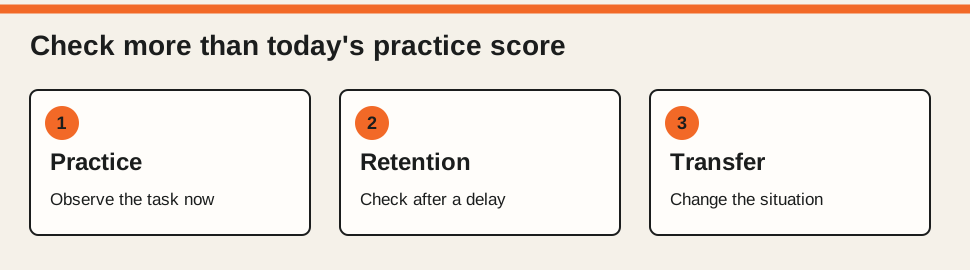
Practice 3. Replace the instruction with a game read
Move to an advantage situation with a teammate and a defender. Now the defender's position determines whether to pass, drive, or shoot. The phone no longer chooses the answer.
A defender protecting the drive may leave the receiver available. A hard closeout may open a route to the basket. A defender who stays away may leave a balanced shot. Teach players to inspect the actual passing window and recovery angle.
A mixed cue schedule trains response selection under an agreed rule. A live possession asks the player to recognize what the opponent has allowed. Connect the two, but score them as different tasks.
Check what survives the delay
At the next practice, briefly test the skill before reminding the player of every correction. Keep a record of the conditions: distance, pressure, available options, and how you define a successful response.
Then change a relevant feature, such as the defender's starting angle or the receiver's location. Look for the same useful preparation in a different situation. Keep the comparison fair enough to interpret.
A few possessions are a coaching observation, not proof of a training effect. Look for a pattern across sessions and use the evidence to decide what to coach next.
Keep the difficulty useful
When nearly every response fails, identify what failed before increasing the pace. When the player responds correctly without looking, change the rule or task in a way that restores attention.
Keep one familiar part while changing another. You may retain the passing distance while mixing cues, then retain the cues while adding movement. Finish with a basketball decision against an opponent.
The goal is a player who can recognize the next problem and bring the right skill to it. Design the sequence around that goal.
Research behind the practice question
Shea, J. B., and Morgan, R. L. (1979). Contextual interference effects on the acquisition, retention, and transfer of a motor skill. Journal of Experimental Psychology: Human Learning and Memory, 5(2), 179 to 187.
The study concerns practice scheduling in laboratory motor tasks. The basketball progressions in this article are my coaching application; the study does not validate the REACT CRT product.
Read the original studySet It Up in REACT CRT
Use these as starting settings for the exercises in this article. Place the phone vertically at eye level and show one cue at a time. Teach the response rule before starting. Give the player enough time to complete the action and reset; increase the interval or shorten the work period when needed. Enter the shown set name and symbols, then use Min Pace, Max Pace, Work Time, and Break Time as displayed below. Min Pace and Max Pace use the same value to keep the cue interval from the original exercise. Save the settings and repeat the exercise for the number of sets listed below the screen.
Example 1. Teach the options before mixing them
Pace (Second)
- Min Pace
- 5
- Max Pace
- 5
- Work Time
- 40
- Break Time
- 20
Repeat: 3 sets.
Player response: R: pass to a ready partner. E: attack the agreed open lane. Rehearse each response separately before starting the changing cue set. Have the partner return the ball between actions.
Progression: Use a brief technical block first if either action is unfamiliar. Keep the two cue format until the player can select and execute both actions with control.
Example 2. Mix three familiar actions
Pace (Second)
- Min Pace
- 5
- Max Pace
- 5
- Work Time
- 40
- Break Time
- 20
Repeat: 4 sets.
Player response: Keep R for pass and E for drive. Add A for a balanced shot. The player reads each changing symbol before choosing the action. A partner and rebounder help the player reset.
Progression: Keep the same interval when adding A. Lengthen it if finishing and resetting take longer. Then remove the cue instructions and let a defender determine whether passing, driving, or shooting is available.