A player can look like an outstanding shooter in practice. The ball arrives perfectly. The feet are set. The defense is missing. Every repetition begins from exactly the same spot, and the numbers look impressive.
Then the game starts.
The pass comes slightly behind the player. A defender is recovering. A teammate cuts into the lane. The shooter has less time and more information to process. That beautiful practice rhythm does not automatically solve the problem in front of the player.
I do not want to choose between teaching good shooting technique and preparing players to shoot in a real game. We need both, but we need them in a sensible order.
The shot starts before the ball arrives
A shot does not begin with the release. It begins when the player recognizes that a possible shooting opportunity is developing.
A shooter who moves without watching the ball may arrive too early. A player who sees the pass but never checks the defender may catch beautifully and discover that there is no time to release. A player who catches in poor balance may need another adjustment step, which gives the defense time to recover.
I ask coaches to look beyond the final result. Before the shot, could the player see the basket, find the defender, read the available space, and prepare for the pass? Did the catch preserve the advantage, or did the player lose it while reorganizing the feet and hands?
The answer determines what we need to teach next.
Check the drill before counting the makes
Picture four players in a drill with one shooter working and three waiting. The shooter follows a route that rarely appears in the offense, receives a pass from an unlikely angle, and repeats it at one flat pace. Even a made shot cannot fix those design problems. Look at who is working, where the pass comes from, how the shooter gets free, and when the feet prepare.
My starting guideline is one part work to two or three parts recovery. Thirty seconds of purposeful work can be followed by sixty to ninety seconds of recovery; some tasks call for thirty seconds of work and thirty seconds of recovery. These are coaching choices, not a universal conditioning prescription. Organize the rotation around the quality of the action and the intended load. Do not let a long line decide the practice dose for you.
Build the route from your offense. Rehearse the cuts and receiving locations your players actually use. Pass from the positions that feed those shots in games, then vary the delivery within that relationship. A pass from the wrong place can make a repetition tidy while teaching the wrong preparation.
Keep the technical foundation
Form shooting, controlled repetition, and attention to body coordination belong in the practice. They help players build a repeatable action. There is nothing wrong with a clear technical task in a calm setting.
The mistake is expecting that environment to answer every basketball question.
Start by teaching the player to arrive balanced, coordinate the feet with the catch, organize the shooting hand and guide hand, and release the ball without avoidable extra movement. Prepare the feet before the ball arrives, rather than beginning the whole setup after the catch. The footwork you teach must be quick and effective for that receiving situation. Choose a manageable shooting distance. Give one clear technical cue at a time and check whether the action improves.
Do not rush from a fragile movement straight into chaos. First establish a useful foundation. Then progressively ask the shooter to perform it in a less predictable basketball situation.
From standing still to arriving ready
In a game, shooters often move into an opportunity rather than wait for the ball to arrive at a fixed station.
Begin with a partner. The passer moves with the ball, and the shooter adjusts to form an accessible passing angle. The shooter must keep the ball in view, meet the pass at the right moment, catch in balance, and be ready for the next action.
Change the approach. Have the shooter relocate from the corner to the wing, move up from the baseline, or arrive after a controlled change of direction. Keep the receiving angle and the timing connected to the passer.
An important correction is that the shooter should not simply run as fast as possible. The player must arrive at the right place at the right time, still capable of shooting. Speed without control can destroy the advantage the movement was supposed to create.
A real defender changes the answer
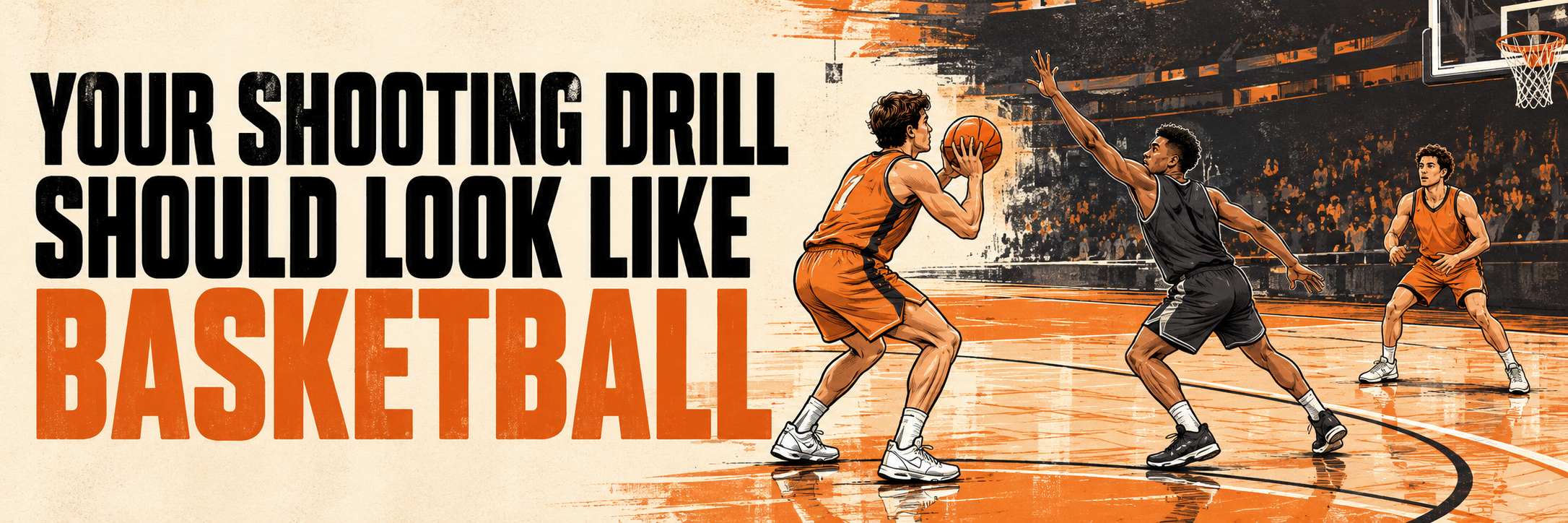
Now add a defender whose action can change the decision.
If the defender is late and the shooter has a balanced, appropriate look, take the shot.
If the defender closes out aggressively and takes away the immediate shot, recognize the available driving lane, passing lane, or need to reset.
If the defender forces a poor catch, do not reward a rushed, difficult attempt merely because the drill is called a shooting drill.
The purpose of the defender is not always to block the shot. The defender creates information. The offensive player has to read that information and choose an effective next action.
This is the distinction between rehearsing one movement and training the recognition that makes the movement useful.
One possession, three possible answers
Imagine a shooter lifting from the corner as a teammate drives from the wing. Keep the ball in view, change pace to reach a usable passing angle, and prepare the feet before the catch. Now read the recovering defender.
If the defender is late and the player has a balanced shot within their range, shoot. If the closeout takes that shot away but opens a driving lane, attack under control. If help arrives in the lane and a teammate becomes available, move the ball. Those are possibilities to read, not an automatic three step script. The catch, spacing, defender and teammates determine the answer.
Repeat the possession with a different closeout. A player who shoots every time because this is a shooting drill has stopped solving the basketball problem. A purposeful pass may be the best repetition of the day.
A practical progression for the next practice
Use the following progression as a practical application. Adjust the pace and complexity to the players in front of you.
Phase one: Build the catch and shot.
Place a passer and a shooter in a realistic half court relationship. The shooter changes location, sees the passer, receives with the feet prepared, and shoots. The coach observes timing, balance, and avoidable adjustment steps. Stay with this until the basic action is dependable.
Phase two: Vary the arrival.
The passer changes the timing and angle of the pass. The shooter may approach from a slightly different path or adjust the receiving spot. The target is not a perfect identical repetition. It is the same sound shooting preparation applied to a changing but manageable situation.
Phase three: Make the shot a decision.
Add a live defender. The defender can arrive late, contest early, or close one route while allowing another. The offensive player must respond to what is actually available. A shot, a controlled drive, or a purposeful pass can each be the correct outcome.
Phase four: Put the decision inside a small game.
Use a short two against two or three against three possession. Create opportunities for relocation, a pass and a closeout. The coach watches whether the shooting habits survive when teammates and defenders are making independent decisions. Return briefly to the technical task if the action breaks down, then reintroduce the live situation.
The progressions can be scaled to age and ability. A beginner may need more deliberate repetition. A more developed player may be ready for faster decisions, narrower windows, and more realistic defensive pressure. Never use complexity as a substitute for a clear learning purpose.
Quality of the rep is more than the make percentage
Recording makes and attempts is useful, but it is not enough by itself to evaluate a game oriented shooting drill.
I want to know four things.
First, did the player create or reach a useful shooting position?
Second, was the player ready when the ball arrived? Check the eyes, timing, foot organization, hands, and balance.
Third, was the decision appropriate? A good shot should be recognized and taken. A blocked opportunity should not automatically become a forced attempt.
Fourth, did the action preserve the next opportunity? If the player passed instead of shooting, did the pass continue the advantage? If the player drove, did the move respond to the closeout rather than follow a script?
Keep a simple practice record that separates shot success from decision quality. A session can show excellent shooting percentages while revealing slow preparation or poor shot choice. Another session may show lower percentages while exposing exactly which reads the player needs to improve. Interpret the numbers in context rather than declaring either session good or bad from one percentage.
Game speed is not the same as maximum speed
A useful shot depends on realistic timing, not on moving as fast as possible every second. Great shooters change pace, find the correct receiving window, stop with control, and release before the defense can organize.
The drill should include enough movement, pressure and unpredictability to resemble the intended basketball action. It should not become uncontrolled running that ruins the player's shooting mechanics, especially before the technical foundation is established.
When a player repeatedly loses balance or rushes decisions, reduce the complexity, teach the missing component, then bring the defensive information back.
A visual cue can add one more layer
When the player is comfortable with the basic basketball task, a visual signal may be used to vary the next choice. For example, a coach can use an agreed signal to indicate which receiving location becomes active. The player must recognize the signal, move with the head up, then still make the real basketball decision based on the passer and defender.
In REACT CRT, a cue must have a clear meaning for that set. The cue is a way to challenge attention and response. It must never replace the live defender's information or turn the basketball action into a disconnected reaction game.
Continue with REACT CRT: connect visual choices to basketball actions, then check the result against a live basketball read.
Keep the added cue brief, visible, and proportionate to the player's level. The best drill is not the one with the most variables. It is the one that helps the player recognize and act on the important ones.
Three questions i would ask after a rep
What did you see before the ball arrived?
What did the defender give you or take away?
Why was your next action the best available choice?
Ask one question at a time. Listen to the player's answer before giving yours. Sometimes the missed shot is a technical problem. Sometimes the shot should never have been taken. The correction depends on knowing the difference.
The real test
If players can shoot beautifully only when everything is predictable, the practice has taught something useful but unfinished.
Build the technique. Add movement. Change the information. Give the defender a real role. Let the player choose.
Our objective is not to produce impressive shooting numbers in an empty gym. It is to build players who can recognize the right moment, arrive ready, and take the right shot when the game is moving.
“Make each day your masterpiece.”