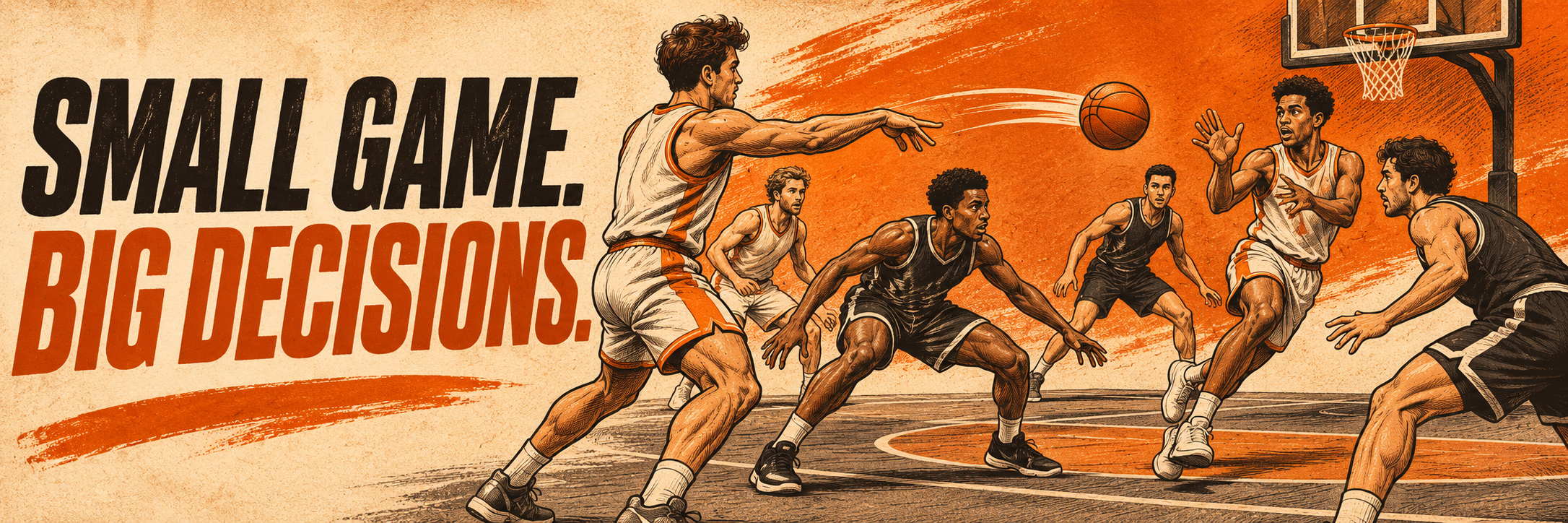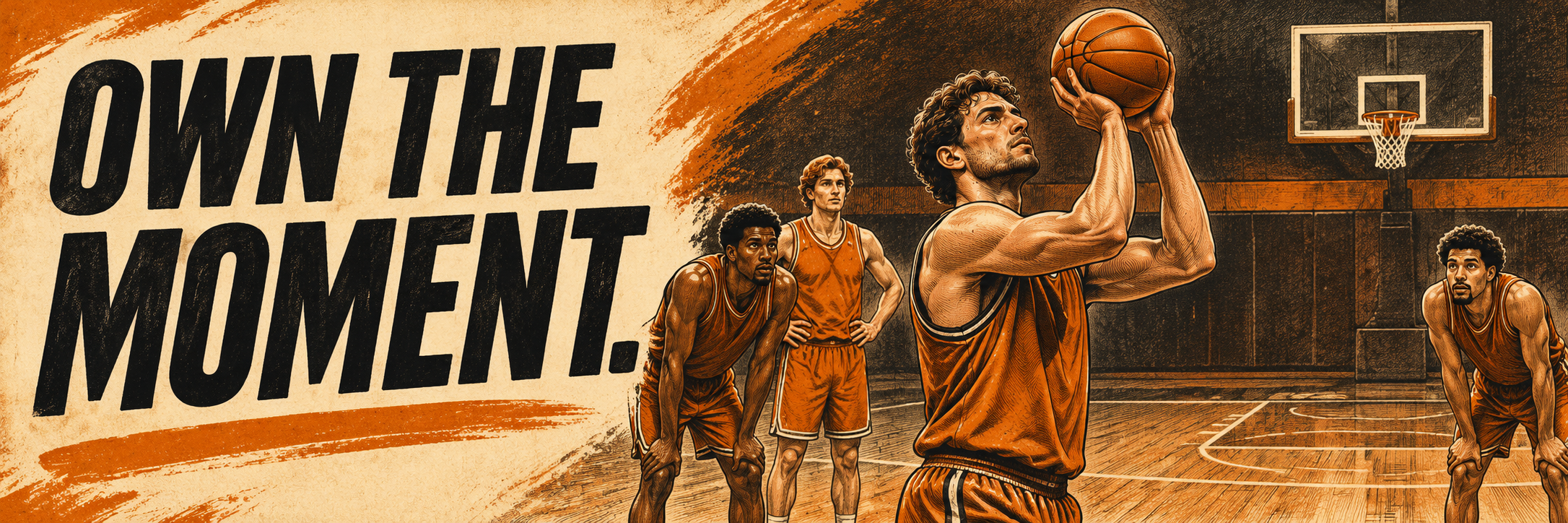
At the free throw line, the player has time. That does not always make the shot feel easier.
Technique matters: stance, grip, release, and rhythm. So do attention, a repeatable routine, and the ability to manage the meaning of the moment.
Shooting a few tired attempts at the end of practice is not the whole preparation. Build situations in which the result matters, while still giving the shooter the time and space to use the routine.
1. Race to 55
Divide into two teams at separate baskets. Players shoot in turn. The first consecutive make earns one point, the second earns two, the third three, and so on.
A miss earns zero and resets the value of the next make to one. Keep points already earned in the team’s running total. The first team to 55 wins.
Ten consecutive makes contribute 1 + 2 + 3 + 4 + 5 + 6 + 7 + 8 + 9 + 10 = 55 points.
You can allow two attempts per player, or let a player continue until a miss with a limit of two to five attempts. Define the version before starting.
2. Build a team streak
Place four to six players at each basket. Players take turns and try to build a shared run of consecutive makes.
First aim for every player in the group to contribute a make without a miss. Continue the sequence and record the best streak. Return to the challenge across practices and try to improve the group’s record.
3. Plus ten, minus ten
Use two teams at separate baskets. Each make adds one point and each miss subtracts one.
A team wins by reaching positive ten. It loses by reaching negative ten.
For a stronger group, you can make a miss worth a loss of two or three points. State the scoring clearly so the pressure comes from a known challenge.
4. Earn the free throw
Two teams line up at a 45 degree angle to the same basket. Players take turns attempting a field goal.
A made field goal earns one free throw. The team receives a point only if that free throw is made.
Stop all other shooting while the player is at the line. Give the earned attempt its own moment.
5. Three on three plus free throws
During a three team rotation, let each player on the inactive team take one free throw. Add successful attempts to that team’s total score.
Organize the free throws at an available basket outside the live game’s space. The waiting group stays involved and the line has a direct connection to the competition.
6. Predict and respond
Before a shooter’s attempt, teammates predict a make or a miss by moving to the designated side.
In the original game, an incorrect prediction means a court run. The shooter joins the runners after a missed shot.
Choose the running distance for the group and keep the scoring consistent. The shooter still has time to prepare. The extra attention should not turn the attempt into a race to release.
7. Four quick repetitions
At separate baskets, players shoot four attempts in succession with a feeder returning the next ball promptly. This version emphasizes the repeated shooting action.
Keep the feeder and shooter coordinated so only one ball is handled for the next release. Treat this as a rhythm exercise with a different purpose from the full game routine.
Give pressure a basketball context
Add a simulated score and a time situation. For example, ten seconds remain, the team trails by one, and the shooter has two attempts.
Ask the player to use a focus word and a consistent routine. Track the routine as well as the result.
I do not use knockout at the free throw line as a substitute for this work. Its urgency teaches players to get rid of the shot, while I want them to take the time the situation provides.
Make the challenge meaningful. Let the player prepare to meet it.
Written and developed by Coach Yoed Agmon. Selected games adapted from his original Hebrew material, with practical coaching explanations.