Free play is one of my favorite ways to teach basketball. That does not mean sending players onto the court without a purpose.
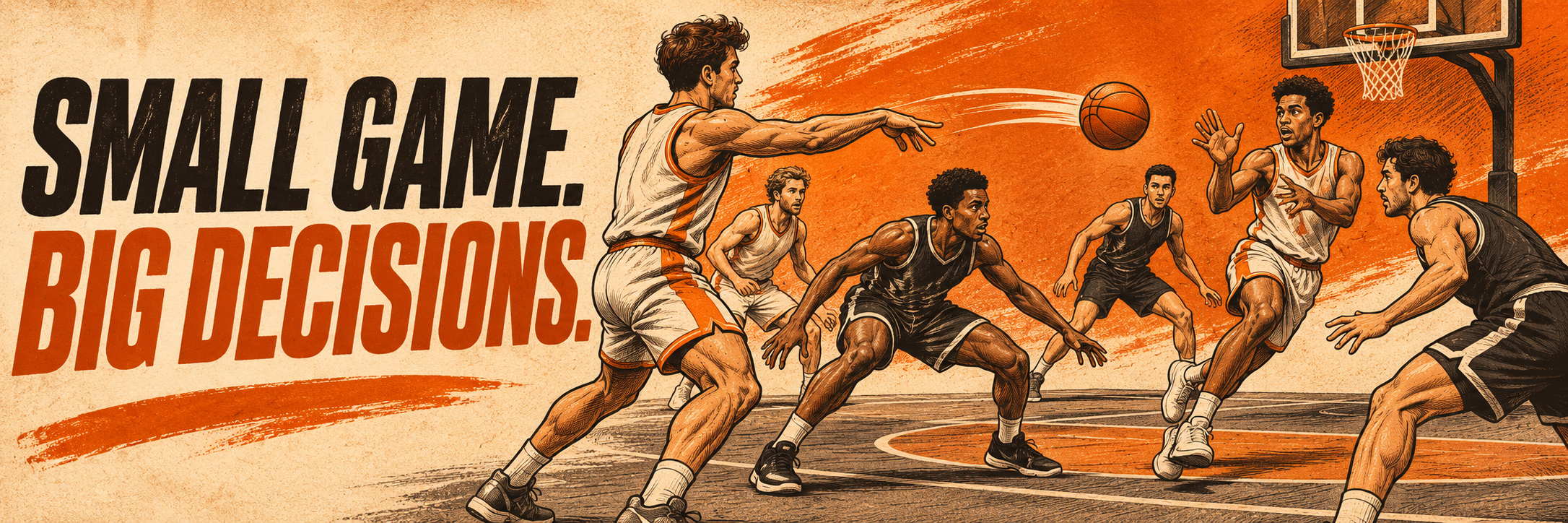
I want a clear framework that makes players recognize a situation, choose an action, and understand its effect on the team. Three on three gives each player more involvement and makes decisions easy to see.
I use several groups of three, including four groups rotating through the practice. Some versions also work with groups of four. Choose a rotation that keeps the action moving and gives the resting group a clear next turn.
Give the dribble a job
The dribble is a tool. Use it to attack the basket, improve a passing angle, escape pressure, or manage a late possession.
I prefer creating an advantage before the first bounce. A useful fake can move the defender’s weight or open an angle, leaving one or two purposeful dribbles to finish the job.
Use one game constraint at a time. Let players experience the problem before adding another rule.
1. One dribble per catch
Allow the ball to advance to half court so the restriction does not break the transition unnecessarily. In the half court, each player may use one dribble each time the ball is received.
May is the key word. The player does not have to dribble. A useful pass or an immediate advantage can be the better choice.
2. Five dribbles for the whole team
Give the offense five dribbles for the possession. One player can use none, one, or all that remain.
The group must track the shared budget and decide when a dribble is valuable. A choice by one player changes the options available to everybody else.
3. One required dribble
Reverse the restriction: require a dribble before the next offensive action.
This can help players organize their body and rhythm rather than rush the next move. Compare the action under this rule with the one dribble limit. Watch what the change does to timing and execution.
4. Passes become points
Each completed pass adds one point to the possession’s bank. The team chooses when to shoot.
A made basket collects the accumulated points. A missed shot loses that possession’s bank.
The decision is whether another pass improves the opportunity or merely delays a good finish. Teach patience without teaching players to turn down every available shot.
5. Reach a position before attacking
Choose a location, such as a post position. The offense must deliver a pass to that position before it can attack the basket.
Now movement and passing have a shared purpose. Players must create the entry instead of simply moving the ball around the perimeter.
6. Attack with fewer players
Play three attackers against four defenders. A larger version can use five against six.
The offense has to work together under a numerical disadvantage. Watch the passing angles, movement without the ball, and willingness to create a useful option for a teammate.
7. Screen away and open two passing lines
Only the screener or the player using the screen may score. Both must create a passing line. If one fails to become available, give possession to the defense.
This emphasizes the whole screening action. The screener has a job after contact, and the receiver must read the space rather than run a route automatically.
8. Reward the open basket
Award three practice points for a basket made without a defender contesting it. Award one for another made basket.
These are the game’s training values, not standard scoring. The incentive directs players toward creating an open finish rather than celebrating a difficult shot as the first solution.
9. Attack any available basket
Play three on three with the offense allowed to choose among the baskets available in the playing area.
Changing the target forces players to notice space, recognize an opportunity, and reorganize. Clearly define the area and the available baskets before starting.
10. Score in ten seconds
Give each offense ten seconds to score.
The short possession makes players organize quickly. Keep looking for a good decision and a useful shot, rather than rewarding a rushed attempt just because it beats the count.
11. Leave the ball and transition
Play normally until the coach’s signal. The team with the ball must leave it and return to defense. The other team takes over and tries to score before the next signal.
The possession can change at an unexpected moment. Players must recognize the new role and react together.
12. Build an advantage through the paint
Choose one version: require a dribble entry into the paint before a shot, require three penetration actions during the possession, or allow finishes only from the paint or beyond the three point line.
Another version uses five attackers against four defenders. A three point basket counts only after a pass has come out of the paint following penetration.
The outside shot becomes the result of an advantage created inside. Do not combine all these restrictions at once.
Coach the reason behind the rule
Ask players what the rule made them notice. Did it create movement, open a passing line, or change the quality of the shot?
Track the behavior you are teaching alongside the score. Then return to a less restricted game and see whether the group can use the principle without the rule.
The aim is independent thinking inside a shared basketball framework.
Related practice from REACT CRT
Related team basketball practice from REACT CRT. This is a related training example, not a demonstration of every game described in this collection.
Written and developed by Coach Yoed Agmon. Selected games adapted from his original Hebrew material, with practical coaching explanations.