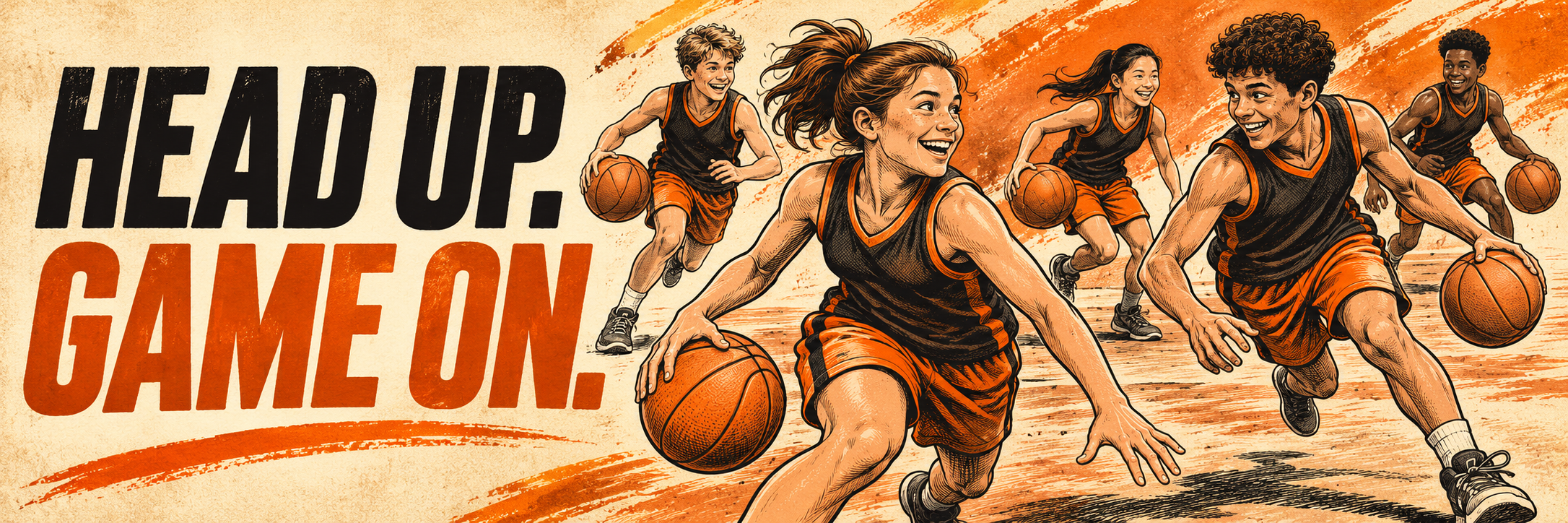
Coaches often ask me for a new dribbling game. The useful ideas are usually already around us: tag, chasing, finding a space, and working with a partner.
Change the task so the player must control a basketball while noticing something else. The ball stays part of the action instead of becoming the only thing the player watches.
These twelve selections are adapted from my original collection. Choose a few that fit the group and give each game one clear coaching focus.
1. Court crossing challenge
Start players in two lines at opposite corners. Set a working time and count completed court lengths while dribbling.
Include work with both hands. Count a length only when the player remains in control. The challenge is purposeful travel with the ball.
2. Dribbling tag
Every player has a ball. The tagger tries to touch another player while everyone continues dribbling.
Use a defined area and light hand tags. Run short rounds, then change the tagger. Watch whether players can see space without losing the ball.
3. Partner pursuit
Work in pairs with one player pursuing the other while both dribble. On the coach’s signal, switch the roles.
The player who was chasing must immediately create space. The player who was escaping must recognize the change and pursue.
4. Chase the next player
Players move in the same direction with even spacing. On the signal, each player tries to catch the player ahead while protecting the space from the player behind.
Keep a common travel direction. This adds awareness of another player without turning the task into a predetermined dribbling pattern.
5. Change speed and finish
Begin with two lines at the baseline. Players start with a slow dribble. At the signal, increase speed and attack the basket for a layup.
Coach the transition in pace and the organization of the finish. Faster travel should still leave the player able to gather and score.
6. Hot boxes
Place a ball supply at each end and divide the group into two teams. Each team travels to the other supply, takes a ball, and returns while dribbling to place it in its own supply.
Play for an agreed time. Organize the travel lanes so players can collect and return without crowding the same path.
7. Find a new home
Use groups of five. Four players occupy the corners of a square, marked with hoops, and the fifth begins in the middle. Everyone has a ball.
Corner players coordinate an exchange of homes while dribbling. The middle player tries to claim a space as it opens. The player left without a home moves into the middle.
8. Cross the river
Players line up at one side of the area with basketballs. A catcher begins opposite them and tries to tag players as they dribble across.
The catcher moves with the crossing action rather than turning back to chase from behind. Tagged players join the catching group. Repeat until the round ends.
9. Rabbits and shelters
Use court circles as shelters. A hunter tries to steal a dribbler’s ball. A player may enter a shelter, but a player already there must then leave.
The shelter provides a temporary option. It also creates information for somebody else, who must notice the arrival and find a new solution.
10. Guard the wall
Mark a long rectangular zone. Three guards stay inside it. Dribblers try to cross the zone without being tagged.
Award a point for a successful crossing. You can also score the guards’ successful tags and rotate the roles. Adjust the width so the game produces a realistic challenge for the group.
11. Match your partner’s move
The coach defines three ball control actions. Partners begin back to back. At the signal, they turn and perform the action they chose.
If both chose the same action, the pair earns a point. This adds recognition and a shared result to familiar ballhandling work.
12. Dribble and hoop relay
Use a relay in which the player dribbles with one hand while managing a hoop with the other. In the original variation, the hoop is around the player’s body and held by the free hand.
Keep the route simple while players learn the combined task. Then vary the working hand or compare accurate completion times.
Keep the game connected to learning
Adjust the area, duration, and pressure to the players. Change roles so the same children do not spend every round chasing or escaping.
Look for one useful behavior: an early look, a protected dribble, a controlled stop, or a timely change of direction.
The game should give players a reason to look up. The coach helps them turn that experience into a usable basketball habit.
Related practice from REACT CRT
Related ballhandling and agility practice from REACT CRT. This is a related training example, not a demonstration of every game described in this collection.
Written and developed by Coach Yoed Agmon. Selected games adapted from his original Hebrew material, with practical coaching explanations.