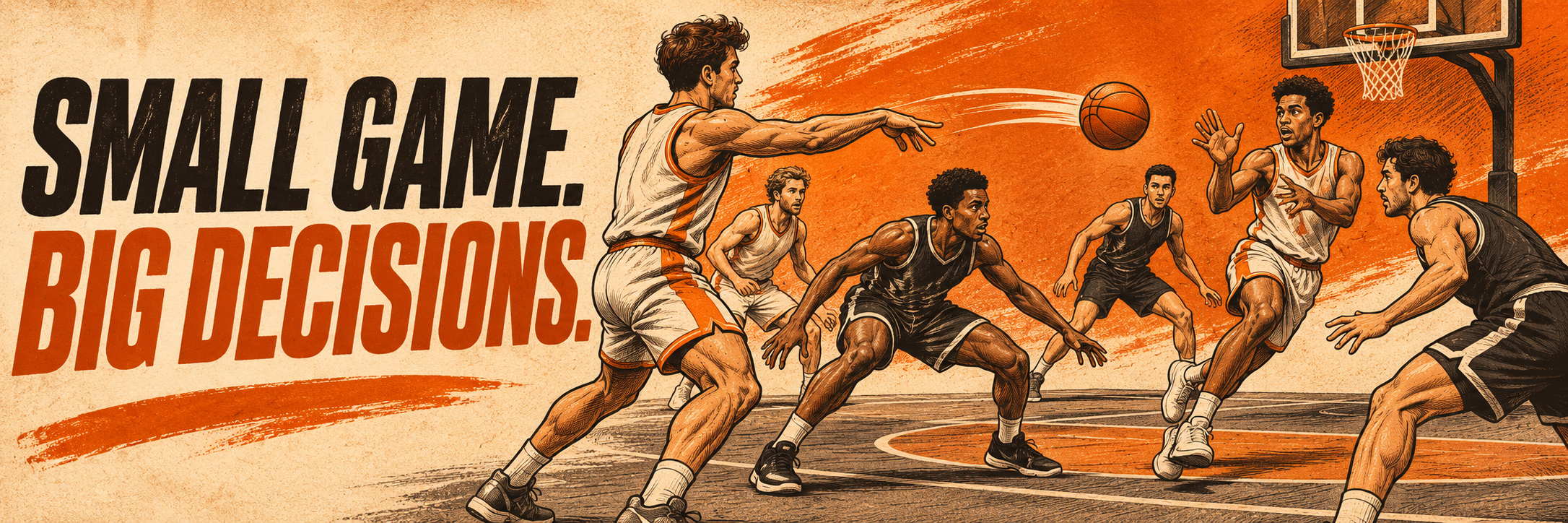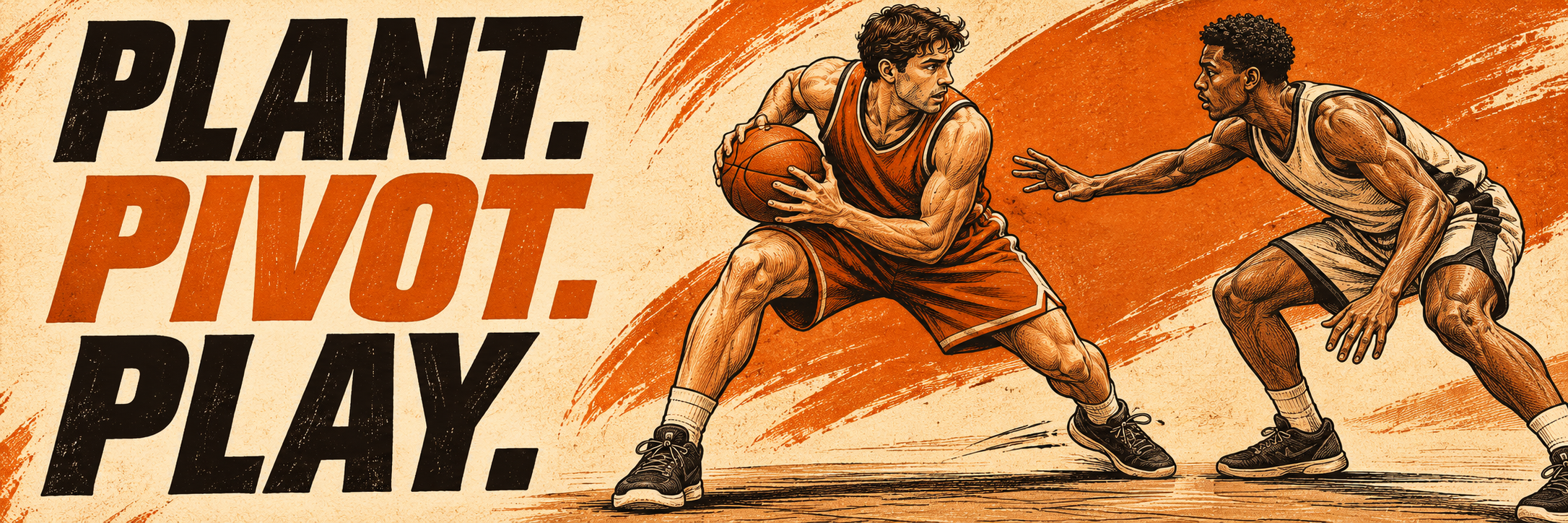
A pivot is more than a footwork rule. It helps a player protect the ball, change the picture, and create the next action.
If we teach it only as a movement in a line, we leave out the defender, the passing angle, and the decision.
These eight selections are adapted from my original pivot game collection. Start with a clear pivot foot and a controlled basketball stance. Add the game challenge without losing legal footwork.
1. Protect the ball
Work in pairs. One player holds the ball in a ready stance while the other tries to steal it.
The ballhandler uses pivot movement and body positioning to keep the ball protected. The defender plays the ball without pushing or grabbing the player.
As a progression, add a second defender. Keep the same objective: preserve control and keep the pivot foot established.
2. Reach the line
Place the attacker a step away from a marked line, with a defender between the player and the target.
The attacker must reach and touch the line with the moving foot while using a pivot. No dribble is needed.
The defender’s position gives the player a problem to solve through balance, angle, and ball protection.
3. Pass, pivot, and tag
One team shares a ball. Players may move when they do not possess it. A player holding it must stay in place except for the pivot.
The other team sends a runner through the defined playing area. The passing team tries to bring the ball close enough for a controlled touch tag while keeping the ball in hand.
Use passes or rolling deliveries according to the group. A progression adds a second ball. The challenge connects anticipation, passing, and a pivot instead of letting the ballholder chase.
4. The wall: An eyes open variation
A line of players forms a wall. In this variation from the original collection, they keep their eyes open and share one or two balls, transferring them through passing and pivot movement.
The other group tries to reach the supply behind the wall and return a ball to its own area. Award one point for a successful return and one for a controlled touch tag by a wall player holding a ball.
Play to ten, switch the roles, and compare the scores. Keep the wall players in their established positions while they use the pivot to help cover the space.
5. The talking clock
Each player has a hoop. Keep one foot inside as the pivot and use the other leg as the clock hand.
A caller announces a time and the players turn the moving leg toward that position. At the agreed change command, everyone seeks a new hoop and the caller tries to claim one.
The player without a hoop becomes the caller. This combines a simple movement picture with listening, balance, and a changing space.
6. Ball fencing
Partners each hold a basketball with their pivot feet close to each other. They try to touch the other player’s ball with their own while avoiding the return touch.
Use controlled movement and light ball contact. The contest is about angle and protection, not swinging at the partner.
Keep checking whether the player can change the ball’s position without moving the pivot foot.
7. Hot box pivot relay
Create two teams with ball supplies and receiving boxes. Arrange the transfers so each player can move a ball from one position to the next using a half turn on the pivot foot.
The team tries to transfer its supply to the receiving box. Keep the distance within the players’ reach so they can complete the action without stepping away from the pivot.
The competition makes repeated turns purposeful while the coach watches balance and control.
8. Tigers in the circle
Place one or two defenders inside a circle of passers. The outside players pass only to a nearby teammate.
Before passing, use a pivot fake toward one side and deliver to the other. The defenders try to intercept or touch the pass.
In the original scoring, completing fifteen passes earns each passer a point. A defender’s touch or interception earns the defenders four points, followed by a role change.
Coach the fake and the delivery as one decision. The player should create a useful angle, not add movement with no effect.
Connect the pivot to the next play
After the game, use a short live situation with a receiver and defender. Ask the receiver to catch, protect the ball, and choose the turn that fits the pressure.
Progress toward a pass, shot, or drive that follows the read. Keep the same footwork standard as the practice becomes more demanding.
The goal is a player who can stop under control and still have options.
Written and developed by Coach Yoed Agmon. Selected games adapted from his original Hebrew material, with practical coaching explanations.