Start with a task players can understand
Four players moving without the ball can look complicated. Start with one clear movement task, then add the next demand when the group can handle it.
This progression builds the shared movement principles of Motion Offense: Principles Before Patterns. Players learn to notice the ball, leave space for teammates, and offer a useful next pass.
Work through the stages according to what the players can read and execute. A short block of about ten minutes across regular practices gives the group time to build the idea. The ten stages are a teaching sequence, not a requirement to finish in one practice.
1. Move between markers through a hoop
Use perimeter markers and a floor hoop as temporary reference points. Ask players to move from one marker to another through the hoop. Begin without a ball so they can attend to their route and the other moving players.
Look for awareness. Players should find the next available space without running into a teammate. Keep the instruction simple enough that they can move and observe at the same time.
2. Add a stationary ball
Introduce a player holding the ball. Keep the ball in one place while the others move relative to it. The ball now gives the group a reference for the strong side and the weak side.
Ask players to keep the ball visible as they travel. Their next position should make sense in relation to both the ball and the teammates already moving.
3. Recognize the space under the rim
Add a brief stop beneath the basket as players move between two perimeter markers. This makes the interior part of the movement picture instead of an area players simply run past.
Keep that stop brief. The player has to recognize when to clear the space for the next teammate. We are building awareness of the route and its timing.
4. Keep the floor balanced
Focus on spacing and avoiding overloaded positions. When two players head toward the same destination, one must recognize the conflict and find another useful space.
Freeze an occasional crowded picture. Let players see what has happened, adjust it, and resume from one action earlier. Before progressing, look for players beginning to make those adjustments themselves.
5. Let the ball travel
Allow passes while the four players without the ball continue moving. Every pass changes the reference point. The group must update its movement as the ball changes hands.
A pass should connect to a teammate who is ready to receive. The passer then joins the movement again. If the whole group stops after each catch, simplify the task until the movement and the pass can connect.
6. Open the first passing line quickly
After a catch, a teammate needs to offer an early, visible passing option. Teach the receiver to open a clear line rather than waiting behind a defender or drifting into a crowded area.
The first available pass helps the possession continue. Other teammates still have to read the space that this action creates. Avoid sending everyone toward the ball to solve the same problem.
7. Increase ball movement
Ask the group to move the ball more quickly while preserving clean catches and useful angles. Players should see the next possibility early enough to prepare for it.
Watch whether the faster ball movement helps the team. Rushed passes into occupied space show that the pace has outrun the read. Reduce the demand and reconnect the decisions.
8. Remove the reference equipment
Take away the markers and hoop. Keep the same attention to shared space, movement relative to the ball, and early passing options.
This stage reveals whether players understand the idea. If they lose their spacing immediately, return briefly to the reference points, clarify the task, and remove them again. The equipment has done its job when players can organize without it.
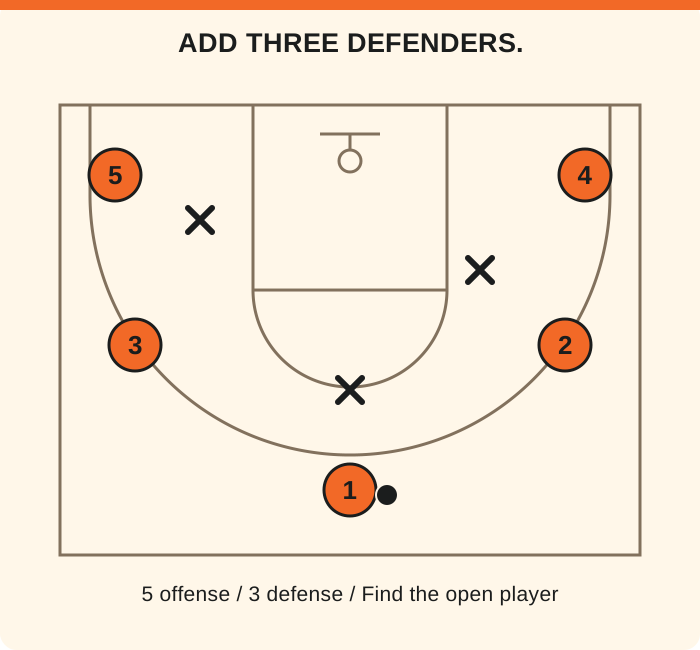
9. Add three defenders
Introduce three defenders against the five offensive players. The numerical advantage gives the offense opportunities to recognize an open teammate while beginning to account for defensive positioning.
Now the pass has to survive a real basketball problem. Watch whether players find the open line, move out of a covered area, and use the advantage before it disappears. Use Freeze and Go for one specific correction.
10. Add five defenders with limited hand pressure
Complete the progression with five defenders. In this teaching stage, defenders keep their hands behind their backs and use positioning to affect the offense. Keep the pace controlled and the task free of contact.
The offense has to respond to five occupied defensive positions while passing pressure remains limited. Once the players can keep the principles under this constraint, a next practice application is to restore normal defensive activity and test the same decisions in live play.
Connect movement to the tools
Develop give and go, movement on the weak side, screens away, ball screens, penetration, and post connections alongside the progression. Add the tools your team is ready to use that season.
The shared principles remain: keep the possession alive, move the ball across and into the defense, open passing angles, and protect a teammate’s opportunity to attack. Avoid cutting directly across the front of the ball handler.
For purposeful constraints that test the next stage, continue with Small Games, Big Decisions. Use Passing on the Move when the group needs more work connecting a pass to its next action.