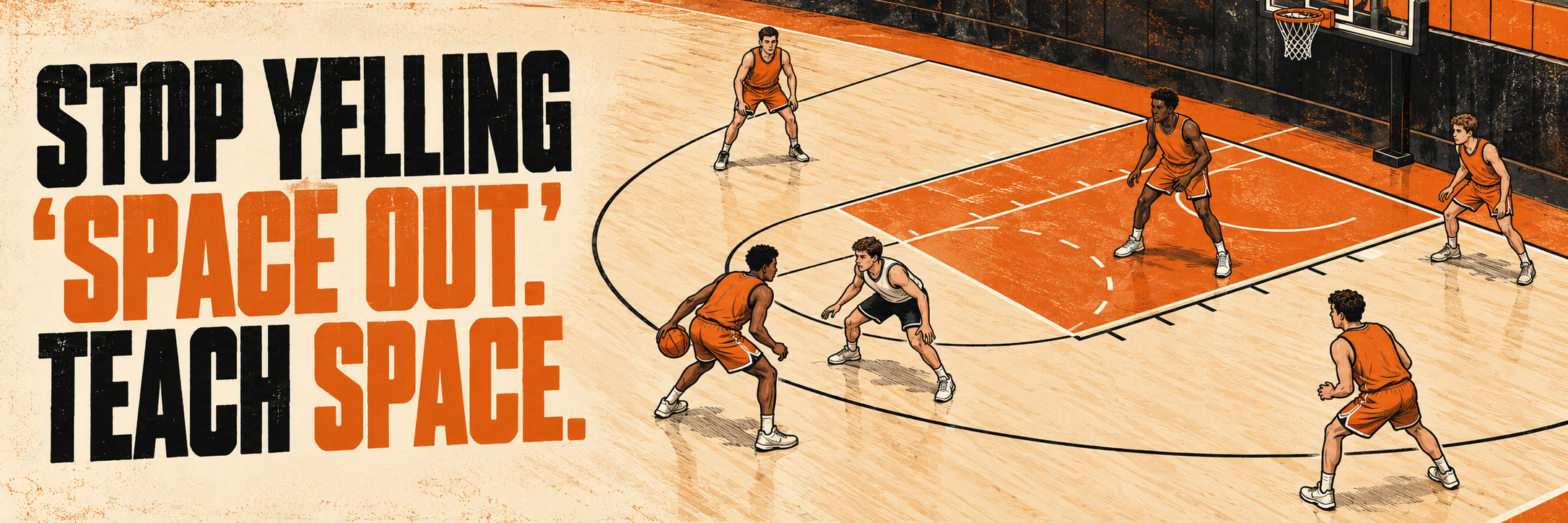
I have watched young players crowd the paint or circle the three point line because nobody showed them how to use the space between. Shouting “space” does not give them a picture. First show them where to move and how that movement opens a passing lane.
Give players a picture they can use
“Open the floor.” “Stop crowding.” “Space out.” Coaches say it all the time. But if a player cannot picture where to go, another shout will not help. Before teaching a team action, teach the space that makes the action possible.
Young players often gather around the lane or follow a painted line. Start with a clear visual reference and a simple instruction. Check what each player understands through movement, rather than assuming everyone sees the same floor.
Open the rectangle
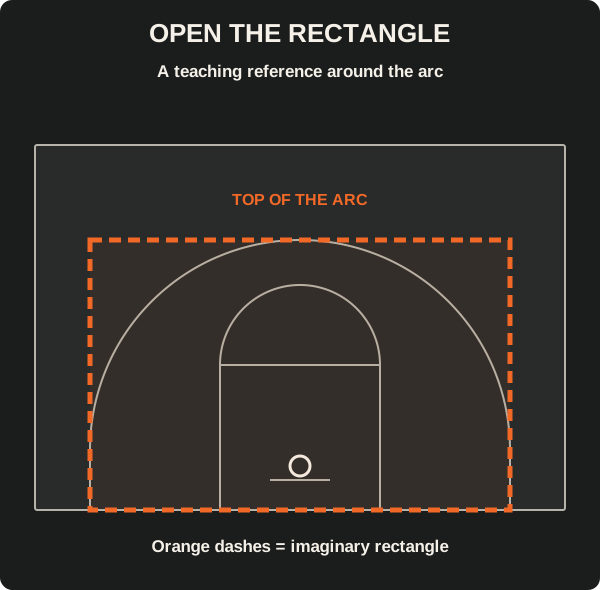
My starting point is a rectangle around the three point arc. Imagine the two sidelines of that rectangle running beside the widest parts of the arc, with its top running across the top of the arc. Use that picture to get players out of the crowded lane and stretch the defense across the floor.
The rectangle is a teaching reference, not five fixed parking spots. As the ball and players move, keep enough width and depth to make the defense cover ground. That gives cuts, drives, and passes room to work.
Move wide. Receive toward the ball.
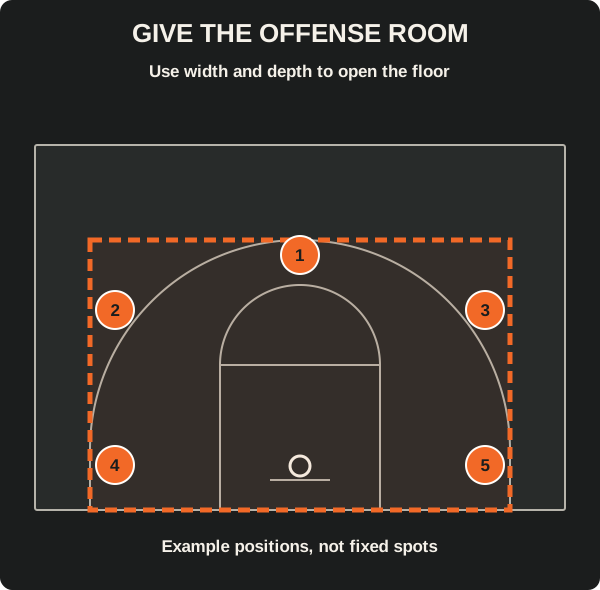
There is a difference between where your movement takes you and where you receive the pass. Move to the edges of the rectangle to open the floor. Then come toward the ball and receive just inside the three point line when the pass leaves room to attack.
Do not wait outside and make the passer do all the work. Meet the pass. Keep the basket available for your next action. Spacing should connect you to the play.
Space must open a passing lane
Standing far from a teammate does not automatically make you available. A passing lane is open when a defender is not between you and the ball along the intended passing path. Adjust your angle as the ball moves so the passer can actually reach you.
Ask two questions: Have I helped open the floor? Can the player with the ball pass to me? Distance without an available passing angle does only part of the job.
Practice 1: Find the rectangle
Players move inside the three point area. On the coach’s call of “Rectangle,” they spread toward the rectangle. The coach passes to one player, who receives and shoots.
Start at a controlled pace. Pause when players crowd the same area, show the available space, and repeat. If the rectangle is too abstract for the group, begin with the three point line as the reference and progress from there.
Practice 2: Spread, meet, shoot
Work in pairs. One player has a ball and moves near half court. The partner moves inside the three point area. On “Rectangle,” the receiver spreads toward the rectangle, checks the spacing, then moves toward the pass, receives, and shoots.
Switch roles. Keep one coaching focus at a time: first reach the space, then meet the pass. A quick shot means little if the receiver never created a usable passing lane.
Carry the same picture into live play
Do not finish the drill and forget the spacing. Keep the rectangle principle present throughout team practice. In motion offense, players need room to read the defense, move without the ball, and create an advantage together.
Progress into small games with defenders. Watch whether the movement opens the floor and makes the next pass possible. Correct the picture, then let players solve the next situation.
“Make each day your masterpiece.”