A timeout starts in practice
A timeout is a powerful tool. Its value depends on when you use it and what your players can do with the message. My approach comes from managing real teams and close games. It gives you decisions to consider, not a rule that every coach must follow.
The useful work starts before the whistle: shared language, familiar actions, practiced special situations, and an honest understanding of what the group can absorb in a short break.
Four ways I use the break
I think about four coaching purposes: influence momentum, reorganize the team, use the opponent’s timeout, and manage the decisive possession. These are coaching categories. They are separate from the official classifications of team and media timeouts.
In a close game, I view the first half, the second half before the final two minutes, and the closing possessions as different management problems. The legal timeout budget changes by competition.
Who gains more from the stoppage?
In the first half, I am willing to use a timeout to keep the game in a useful range, settle the pace, and prevent an opponent’s run from taking over.
Later, I often try substitutions, a defensive change, or a change of offensive rhythm before spending a timeout only to stop momentum. I want tools available for the closing possessions, within the limits of the rules.
Every break also gives the opposing coach time to organize. When we lead by four late after conceding a basket, continuing to play may force the defense to cover the full floor and make decisions on the move. A timeout may let it set pressure or plan a foul.
The question I ask is practical: who benefits more if we stop now? The answer still depends on our ability to advance the ball, the clock, and the players on the floor.
Reorganize when there is a real problem
A short rotation may need a recovery opportunity. A repeated offensive rebound or an action we cannot stop may need a direct correction. If substitutions or a coverage change do not solve the problem, the timeout can restore control.
Use the opponent’s timeout as working time too. A defensive change or pressure may cause the other coach to stop the game. Be ready to use that break without spending your own allocation.
One third diagnosis. Two thirds next action.
Before calling it, breathe. Once it is granted, breathe again. Arrive with a message.
My structure is roughly one third on what is failing and two thirds on what we do next. Choose two or three clear points from the game and from work the players already know.
In a close game, I often start with what is working: our ball pressure, our defense, our transition opportunities. Then name the specific correction. We have a base. We have one job to improve.
Fit the message to the available time. A 30 second timeout requires an even tighter message than a full break.
The board should remind them of something
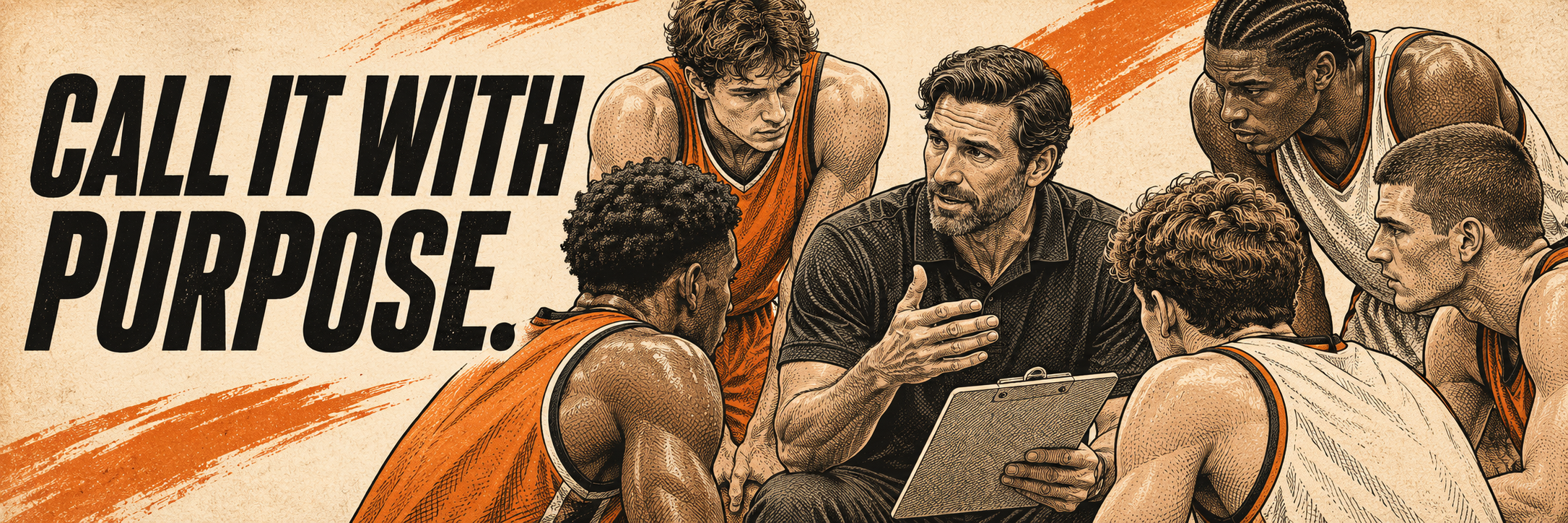
Use the tactical board in practice if you expect players to read it under pressure. In the huddle, show a familiar action and identify the adjustment.
Practice the late inbound, the pressure release, the quick shot, the possession that uses the clock, the needed three, and the possession where you must prevent a three.
The play you pull out of the hat should be the one you put there in practice.
A timeout can manage the season
In one promotion season, we trailed by 15 at halftime and by more than 20 during the third quarter. Early in the fourth, I used a timeout to set a different objective: keep competing and finish within 15, because scoring margin could matter later.
We finished nine points behind. In my account of that season, the result affected the wider promotion picture as other teams’ results developed. The point was to give the players a meaningful job when winning that night looked unlikely.
A coach manages the group and the season as well as the current score. That example comes from a competition where scoring margin mattered. Apply the lesson to your own standings rules.
Same coaching problem. Four different rulebooks.
Rules checked November 3, 2026. FIBA is the international comparison point. NBA, NCAA men, and NCAA women each have their own rules. The college rows below use the electronic media format; the nonmedia formats are listed separately.
| Competition | Regulation budget | Duration | Overtime and carryover | Who can request and when |
|---|---|---|---|---|
| FIBA | 2 in first half; 3 in second, maximum 2 available at 2:00 or less in Q4. | 60 seconds. | 1 per overtime. Unused allowances do not carry into the next half or overtime. | Head coach or first assistant, through the table. Opportunities include a dead ball with the clock stopped after table communication, a successful final free throw, or an opponent’s basket. |
| NBA | 7 in regulation; maximum 4 in Q4; maximum 2 after the later of 3:00 in Q4 or the end of its second mandatory timeout. | Additional team breaks: 75 seconds. Mandatory breaks: 2:45 local / 3:15 national. | 2 per overtime. | Player in game or head coach; dead ball or their player controls the ball. |
| NCAA men, media format | Three 30 second breaks and one 60 second break. Only two of the 30 second breaks carry into the second half. | 30 or 60 seconds; media conversion can extend the break. | Unused breaks carry over; add one 30 second break per overtime. | Player with control. Head coach during dead ball; live ball exceptions for own throw in before release, and own control in final 2:00 of second half or overtime. |
| NCAA women, media format | Three 30 second breaks and one 60 second break. | 30 or 60 seconds; media conversion can extend the break. | Unused breaks carry over; add one 30 second break per overtime. | Player or head coach; own player control or a dead ball. During a throw in or free throw disposal, only the team entitled to the ball. |
FIBA: Article 18, 2026 edition. NBA: Rule 5, Section VI. NCAA: Rule 5 and the official 2026/27 media guidance and comparison documents. Request restrictions have additional exceptions, including airborne player restrictions; consult the linked rulebook for the exact situation.
Media breaks change the timeout decision
FIBA media breaks are competition dependent. Do not import a particular league’s television schedule into the general FIBA rule. The ordinary FIBA timeout is a full minute, not a separate 50 second allowance. FIBA 2026, Article 18 and Appendix E.
NBA mandatory breaks occur at the first dead ball after the 6:59 and 2:59 thresholds if the required breaks have not already occurred. They are charged to teams under Rule 5. NBA Rule 5.
For NCAA men, the media agreement sets the marks. The first team timeout in the second half takes media length. A team timeout within 30 seconds before a mark, or creating the first dead ball at or below it, can fulfill the scheduled break. NCAA men, 2026/27 regular season.
For NCAA women, one media break is scheduled at or below 5:00 in each quarter. A preceding team timeout or replay review can trigger it; the first such event of the second half also triggers a separate second half media break. NCAA women, 2026/27 table crew guidance.
College games without the media format
NCAA men: four 75 second timeouts plus two 30 second timeouts in regulation. NCAA women: two 60 second timeouts plus three 30 second timeouts. Do not use the media allocation automatically in these games. Official 2026/27 NCAA comparison, timeout section.
Advancing the ball is another separate decision
FIBA permits a qualifying backcourt possession to move to the frontcourt after a timeout in the final 2:00 of Q4 or overtime. NBA also offers a late advancement option, with conditions on whether the ball has already been advanced. NCAA women have a qualifying option in the final 59.9 seconds of Q4 or overtime. NCAA men do not have that timeout advancement option.
An automatic dribble or pass after gaining possession can change eligibility in NBA and NCAA women. Know the exact starting situation before asking players to use or save a timeout. FIBA Article 17; NBA Rule 5; NCAA women Rule 5, Section 14; NCAA comparison, throw in section.
Build your plan around the rules you play
Assign an assistant to track the timeout budget, the next media opportunity, and the conditions for advancing the ball. Rehearse the communication before the season.
My preference to preserve late options must fit that budget. In FIBA, you cannot keep all three second half timeouts for the last two minutes. In NBA, a different late limit applies. NCAA men and women use different structures again.
Practice the huddle under the actual time limit, then play the next possession immediately. Ask a player to repeat the job before the group returns. The message has value when the next action is clear.
“Make each day your masterpiece.”