A preseason win can hide a team that is still unprepared. A loss can reveal exactly what the next week of practice needs. Before scheduling the opponent or choosing the lineup, decide what you need the game to show you.
I separate preseason games into two categories: games for building the team and games for preparing the team to compete. Both involve live basketball. They ask different questions and require different decisions from the coach.
In the first, I need to discover what the group can do. In the second, I begin managing it closer to the way I expect to manage a regular season game. Players should understand which job we are doing before the ball goes up.
Games for Building the Team
Early in the preparation period, the roster is still giving us information. We are learning which players can handle pressure, who communicates early, and which combinations help one another. Returning players need a fresh look too. A change in strength, role, confidence, or decision making can change the team's possibilities.
I introduce team concepts early for three reasons: to find out what works, to build game readiness progressively, and to connect the players through shared actions.
The first scrimmages should help answer those questions. I may test a lineup that would not be my best group for protecting a late lead. I may leave a reserve in a difficult matchup long enough to see the read and the response. I need information that a safe, familiar rotation would never provide.
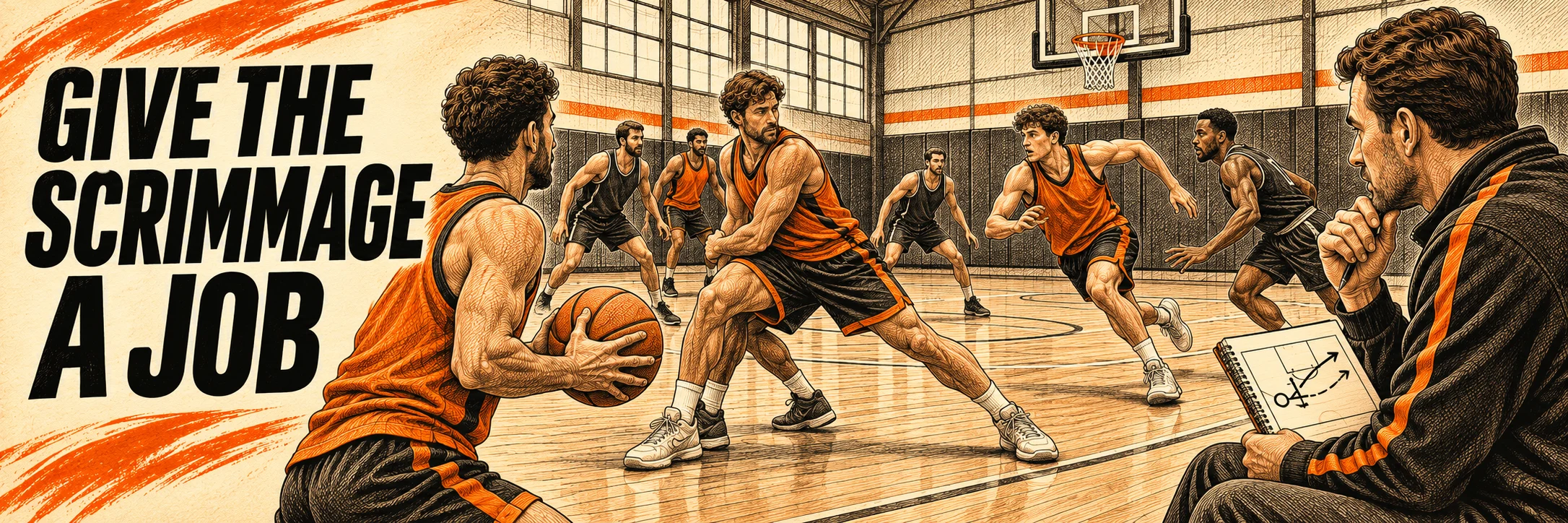
That requires purposeful freedom. Give the player a job, allow real decisions, and watch what happens. If the player makes an error, identify whether it came from the read, the technique, or an assignment the group has not learned. Repeating confusion without a correction adds little.
Games for Preparing to Compete
Closer to the season, I want the team to experience a more realistic management rhythm. Rotations begin to reflect expected roles. The defense must recognize the calls. The offense must find its next action when the opponent removes the first.
Now I need to see whether the group can carry its work through the flow of a game. Can we organize after a substitution? Start the second half with purpose? Handle a run without abandoning the offense? Get to the finish with players who know their jobs?
An exhibition game may provide this setting, but its designation matters. A controlled practice scrimmage, a closed scrimmage, an exhibition, and a regular contest can have different permissions and administrative requirements. Follow your competition's rules when arranging the event and any modified playing conditions.
Agree with the other staff before the session if you want special situations, altered segments, or a teaching stoppage. Those are appropriate tools in an agreed practice format. They should not be introduced unexpectedly into a game being played under standard competition conditions.
Find the Pairs Before You Fix the Five
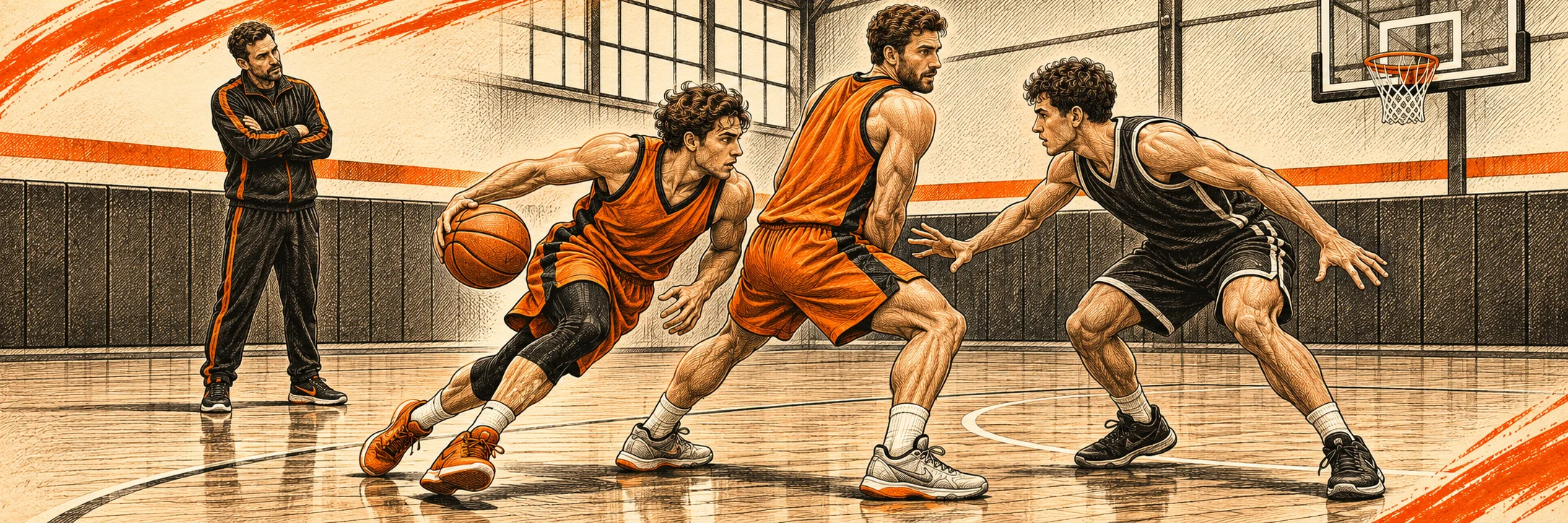
A starting five is only part of the picture. I want to know which two players make one another more effective.
Does the guard deliver the ball when the roller becomes available? Does a screener recognize the defender's angle and arrive set? Does a cutter move when the ballhandler gains an advantage? Can two defenders communicate a coverage without both committing to the same job?
A useful pairing can stabilize several lineups. A guard who helps an inexperienced big receive in balance may create a combination worth developing. A shooter who relocates with a particular driver's first step may provide an outlet that a list of individual shooting percentages misses.
The next layer is a group of three. In a ball screen, the third player may be the weak side receiver who moves as help commits. On defense, the third player may be the one who covers the pass after the first rotation. Watch whether the three recognize the same picture in time.
Do not conclude that a combination works simply because its first two shots went in. Track whether it repeatedly creates a usable advantage and whether the players understand what made it available.
Choose an Opponent for the Question You Need Answered
A manageable opponent can give a young group room to organize. A stronger opponent can expose habits that easy games leave untouched. Both can be useful when the purpose is clear.
If you need to test pressure release, an opponent that rarely pressures the ball may not provide the right evidence. If you need to see whether your interior defense can handle size, a small opponent asks a different question. If the group needs to learn how to sustain its offense, an overwhelming mismatch may leave too few playable possessions to assess it.
Sequence the preparation with the roster's readiness in mind. The goal is a useful challenge that gives you something concrete to coach next. The opponent's reputation and the final margin do not define the value by themselves.
Set One or Two Priorities Before Play
Tell the players what you are evaluating. A scrimmage can contain many coaching observations, but the group needs a small number of shared priorities.
For a pressure segment, our priorities might be a second outlet and controlled advancement. For an offensive segment, they might be arriving with spacing and making the next pass when help commits. On defense, they might be the first communication and the rebound that ends the possession.
Keep the feedback attached to those priorities. If we have agreed to evaluate the pressure outlet, do not spend every stoppage discussing an unrelated shooting detail. Record it for later unless it needs immediate attention.
The same standard applies after a mistake. Explain the specific breakdown, make the correction, and let the next possession test whether it helped. Players learn little from being told to concentrate harder without knowing what they missed.
Create Situations the Score Alone Will Not Give You
A controlled scrimmage lets us rehearse problems that a normal game may never produce at the right time. Start a segment down six with four minutes left. Give the lead group a realistic foul count. Have the defense deny the preferred inbound receiver.
State the conditions before play. Use the actual clock, shot clock, timeout allowance, and foul rules for the competition you are preparing for. If the segment is a teaching simulation, everyone should know that its starting score is part of the scenario.
Include moments when we lead but have lost control of the possessions. The scoreboard may still look comfortable while our rushed shots and missed boxouts feed the opponent's run. The players and staff must recognize the direction of the game before the lead disappears.
Until the final buzzer, read who is dictating the game. In the scrimmage, also ask whether our adjustment changed the specific behavior we were trying to improve.
Observe More Than the Final Margin
A small observation sheet is more useful than a page of numbers nobody will act on. Separate what happened from the reason you think it happened.
| Question | What to record | What it may change in practice |
|---|---|---|
| Can we handle pressure? | Live ball turnovers and the available outlets on those plays | Support spacing, receiving angles, and the first pass |
| Which pairings create an advantage? | The action, defensive response, and next decision | Pairing repetitions and role assignments |
| Do we finish defensive possessions? | The first contest, contact with rebounders, and who secures the ball | Rebounding responsibilities and floor balance |
| Can we execute a change? | Who called it and whether all five arrived at their assignments | Communication and the transition between coverages |
| Are we ready for the finish? | Inbound options, clock awareness, and decisions under the set conditions | Specific closing situations to rehearse |
Use film when available to check the observation. A turnover charged to the passer may begin with a receiver who never creates a passing angle. A conceded basket may follow a late rotation two passes before the shot. The statistic identifies a possession worth examining; it does not always identify the player or action that caused the breakdown.
Build Readiness Without Turning Every Session Into a Test of Survival
Live play supplies decisions, contact, and movement that isolated work cannot fully reproduce. Manage that demand progressively. Know the players' current readiness, the rest between segments, and the physical work already completed that week.
A player who can no longer move or read at the required level is giving you different information from a player facing a fresh tactical problem. Adjust the segment when fatigue or a medical concern makes the planned work inappropriate. More exhausted minutes do not automatically mean better preparation.
Use the session to prepare the bench too. Reserves need to follow the game, recognize the call, and enter with a clear assignment. Rehearse the overlap between ballhandlers and the support around an incoming player before trying it in a difficult road game.
Review the Session in Three Steps
First, establish what happened. Choose a few possessions that represent the agreed priorities. Describe the position, the available information, and the action the player chose.
Second, identify what needs work. Separate the player's read from the ability to execute it. A correct pass that arrives late asks for a different correction from a pass to a covered receiver.
Third, plan the next opportunity to improve. Give the team an action it will rehearse, one or two teaching points, and a live situation that will test the change. Return to the same problem in the next scrimmage or practice segment.
A brief review should leave the players knowing what to do. It should also leave the staff knowing what it must teach more clearly.

Carry the Learning Into Game Management
The information from these games should affect our rotations, pairings, defensive options, and closing plans. If nothing changes after the review, ask whether we gathered the information we actually needed.
Use Substitutions: Change the Game, Not Just the Lineup to turn those observations into rotation decisions. Use Change the Defense With a Purpose to rehearse adjustments. The separate timeout article covers the break itself, and Coach the Game Toward the Final Two Minutes connects the whole plan.
A preparation game should leave us more ready for the next one. Set its job before tipoff, coach that job during play, and use what it reveals.
“Make each day your masterpiece.”