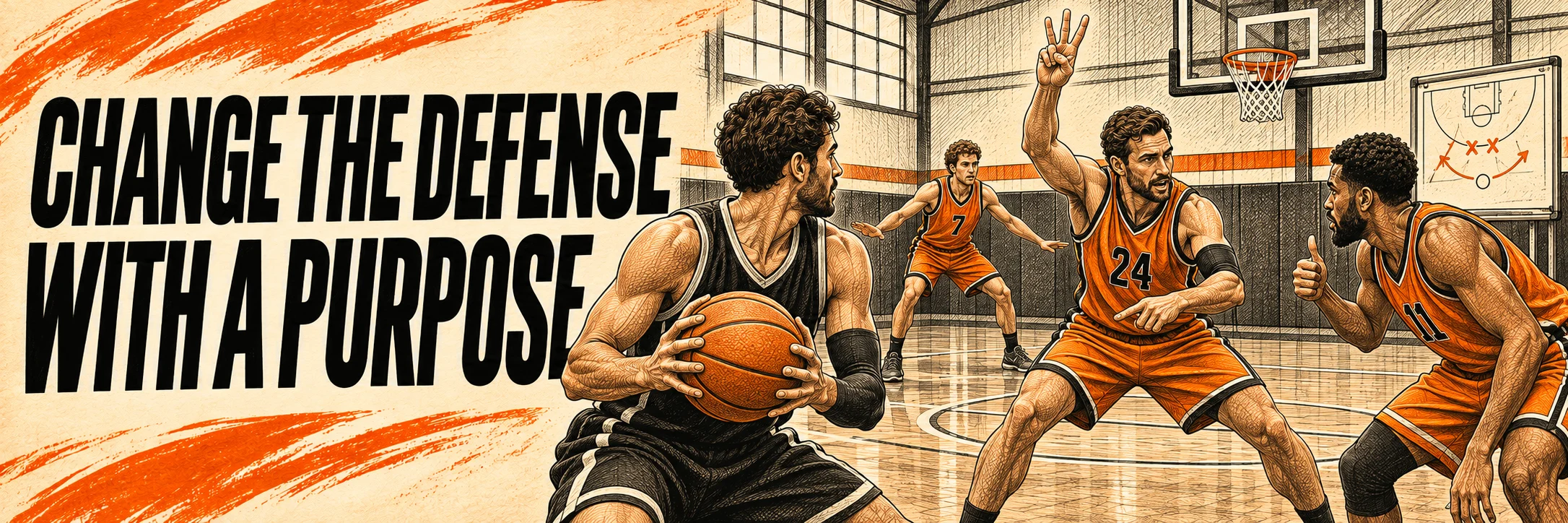
Before calling a timeout, look at the possessions. Where are the easy points coming from? What is the opponent finding without having to work? Which job are we failing to complete?
A practiced defensive change may let us answer that problem while the game continues. It can take away a preferred entry, change a ballhandler’s first read, or give our players a clearer assignment. Changing the name of the defense accomplishes little if the same breakdown remains.
Until the final buzzer, coach the momentum. At the buzzer, the scoreboard settles it.
We can lead and still be losing control of the game. We can trail while making the opponent work harder and taking away what created the deficit. The score determines our situation. The possessions tell us which way it is moving.
Define Momentum in Basketball Actions
For coaching purposes, I look at three connected signs: the chances each team is creating, the decisions each team is forcing, and the ability to finish possessions.
A team getting downhill on every trip is imposing a problem. A team making the opponent restart its offense is imposing a different one. A defense that contests well but gives up the rebound has still left the possession unfinished.
An eight point run may come from repeated advantages or a short stretch of difficult makes. Read what happened. Do not assume every missed shot means our defense worked, or every basket means the coverage failed.
If we are six points ahead but keep surrendering paint catches and offensive rebounds, I want to act before the lead disappears. The scoreboard cannot tell me which coverage to use. The source of the opponent’s advantage can.
Four Reasons to Change the Defense
I separate defensive changes into four purposes: a planned change, a change to interrupt the opponent’s momentum, a change to extend our own control, and a change to prevent the game from breaking open.
1. A Planned Change
Give the players a recognizable trigger. After a made free throw, pick up in a practiced press. After a specified offensive call, move into the prepared coverage. After the first pass, change the defensive picture only if the whole team understands the action.
The point guard or another designated communicator can make the call. Everyone must hear or see it and confirm it. The player nearest the ball cannot assume the three players behind the action received the message.
Practice the change itself. Starting five defenders in a settled alignment teaches the destination. Players also need to reach it from the positions a live possession gives them.
2. Interrupt the Opponent’s Momentum
If the opponent keeps entering the same action comfortably, make that first read different. A practiced zone may change the passing windows. A matchup change may remove a target. A different ball screen coverage may make the ballhandler release the ball sooner.
Name the advantage we are trying to remove. Then name the opening our adjustment might concede. A trap that gives up an uncontested release pass has changed the picture without necessarily improving it.
For example, the opponent’s guard has reached the paint through the same middle ball screen twice. A prepared change in coverage may force the pass earlier. Now the other three defenders must know who tags the roller, who covers the release, and how we recover. The call only works when all five jobs connect.
3. Extend Our Own Control
Sometimes the change is made while we are playing well. After a good offensive possession, a prepared pressure package may make the opponent spend time organizing and prevent a comfortable answer.
Use the pressure your personnel can sustain. A lead does not justify gambling. A large first half advantage is still a first half advantage. If the opponent breaks our press into repeated layups, we are helping it return to the game.
Keep options available for later. Showing every pressure variation early can give the opponent time to identify the releases. A simpler package executed well may be enough.
4. Prevent the Game From Breaking Open
When the game begins to unravel, reduce the problem to something the group can execute. Step back from the emotion long enough to identify the source of the easy baskets.
If transition is hurting us, stop sending players after low percentage steals. Get behind the ball, protect the rim, and organize the matchup. A new half court scheme cannot repair a defense that never arrives.
If deep paint catches are the problem, change the entry pressure, help position, or alignment according to your practiced system. A more compact defense may protect the paint, but it also requires a clear plan for dangerous shooters and the defensive rebound.
If the opponent is scoring from several areas, establish a defensible priority. Decide what we are prepared to concede for the next stretch and communicate it. “Guard everything harder” gives an unsettled team no usable direction.
Keep a Shared Defensive Language
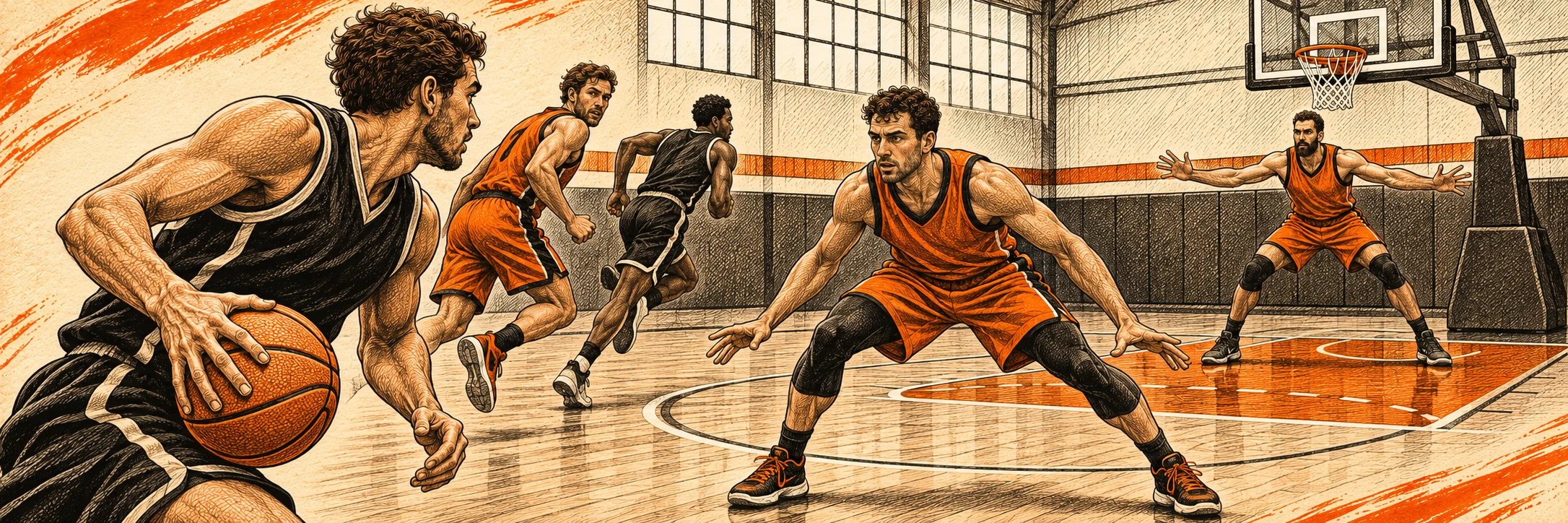
I prefer one or two defenses we can execute reliably over a long list of schemes we barely know. My base is a dependable man defense and a compact zone, with pressure packages built from principles the players understand.
The alignment can change while the language stays familiar. Players should recognize how we close out, how we influence the ball, when help comes, and how we finish with the rebound.
Some coverages require different responsibilities. Teach those differences explicitly. Do not expect players to infer that the same word now means a different help position or recovery route. With limited practice time, unnecessary contradictions become live game hesitation.
A defensive change should give players a manageable adjustment. If it requires a sideline lecture every time, it is not ready to be used while the ball is live.
Match the Response to the Source of the Points
| What you see | An adjustment to consider | What must be protected |
|---|---|---|
| Transition layups after our rushed shots | Improve offensive floor balance and get back before applying pressure | The rim, the ball, then the next receiver |
| Repeated deep post catches | Change entry pressure and the prepared help position | The weak side pass and the rebound |
| Clean shots for a particular shooter | Change the matchup or coverage attention | The drive and the next rotation |
| Repeated paint touches through a ball screen | Use a practiced coverage variation | The roller, release pass, and recovery |
| Putbacks after a reasonable first contest | Fix contact and rebounding assignments; change personnel if necessary | Finishing the possession |
| Players who no longer understand the call | Simplify to a familiar coverage or use a focused timeout | One shared instruction all five can execute |
These adjustments require the personnel and practice to carry them out. A zone does not automatically solve outside shooting. A switch does not remove every mismatch. A press does not guarantee turnovers.
After the change, check whether the targeted opportunity has become harder to create. Also check what the opponent is getting instead. One missed open shot should not convince us that a poor defensive possession was successful.
Connect the Coverage to the Five Players
Sometimes the defense needs a different player as well as a different call. A mobile big may make a higher coverage workable. A strong rebounder may allow a smaller group to finish possessions. A guard who communicates early can help the whole unit arrive together.
Other times the missing player is on offense. If repeated turnovers and rushed shots feed the opponent’s transition game, a composed ballhandler or a player who creates a reliable scoring action may help the defense more than another defensive substitution.
Read Substitutions: Change the Game, Not Just the Lineup for the rotation decisions. The call and the five executing it must be considered together.
Changing Momentum Has More Than One Route
A defensive change is one tool. We can also change the offensive tempo, use a different entry, involve a neglected matchup, add a second ballhandler, improve floor balance, or make a specific communication correction.
Suppose the opponent has scored on three consecutive possessions. If those baskets came after our live ball turnovers, the first intervention may be a better pressure outlet. If they came from putbacks, the first intervention may be contact and rebounding. If the players cannot understand a repeated breakdown while play continues, the timeout may be necessary.
A timeout also gives the opponent a chance to adjust. Preserve it when a prepared change can solve the problem. Use it when the team needs a correction it cannot execute without stopping. The detailed huddle and rule differences are covered in Timeouts: Know When to Stop, Know When to Play.
The coach’s behavior matters too. Give the player at the point of the breakdown a clear instruction. Reinforce the defender who completes the assignment. Show the group what we can control on the next trip. Anger without information does not establish a coverage.
Adapt the Defense to the Competition
A compact FIBA zone cannot be copied unchanged into the NBA. Under the NBA defensive three second rule, a defender in the specified lane area must actively guard an opponent within three seconds unless an exception suspends the count. The rule defines active guarding as being within arm’s length and in a guarding position. NBA zones must account for that requirement.
Personnel and timing differ too. A defensive package for a 24 second clock may face a longer sequence under the NCAA’s 30 second clock. In NCAA men’s basketball, halftime divides two halves rather than four quarters. Plan your changes and recovery opportunities around the game you are actually coaching.
Youth competition rules may restrict pressure, zones, or particular alignments. Check your league before introducing a package. Keep the detailed timeout comparison in the separate timeout article rather than assuming every American competition follows NBA rules.
Practice the Change Under Live Conditions
Use three situations to teach the reading and the transition into a new coverage. Assign one or two coaching points before each segment.
First, play through a planned trigger. Begin in your base defense, call the change after a made free throw or another defined event, and let the offense play freely. Check the communication and the first assignment after the change.
Second, give the offense a repeated advantage. Let it attack the same entry or screening action. The defense must identify the source, make a practiced adjustment, and complete the next possessions. Review both the targeted action and the opening conceded elsewhere.
Third, start with a lead while the opponent has the recent run. Require the coach and players to respond to the possessions rather than the comfort of being ahead. Play the clock honestly. If the adjustment fails, identify the reason and replay the situation.
Do not reward a change only because the next shot misses. Check whether all five understood it, whether it addressed the actual problem, and whether the possession ended with control of the ball.
The objective is to make the opponent work in a game we can manage. Keep reading it until the final buzzer.
Rules and Further Reading
NBA Rule 10: Violations and Penalties, Section VII, defensive three seconds. NBA Rule 7: Shot Clock. NCAA 2026/27 rules comparison, timing and shot clock. Rules checked November 6, 2026.
“Make each day your masterpiece.”