A stronger opponent wants its advantages to show early. More size. More depth. More pressure. More possessions in which those advantages can work.
Too many coaches accept that invitation. They try to win the game in the opening minutes, rush their offense, press beyond their personnel, and spend their best players chasing a pace the other team prefers. By halftime, they have helped create the game they needed to avoid.
My approach against a stronger opponent, especially on the road, starts with a different question: What must we do now to reach the final two minutes with a real chance to win?
That question shapes the opening possession, the rotation, the defensive plan, and the resources we preserve for the finish. It also shapes how I teach players to understand the game.
I divide that work into three stages: the first half, the second half before the final two minutes, and the closing possessions.
First Half: Keep the Game on Your Terms
There are games in which attacking immediately and forcing the pace makes sense. Your matchup, depth, shooting, or ability to create turnovers may justify it. Playing at home can also influence how confidently your team handles the opening stretch. None of that makes a fast start the right plan for every opponent.
Against an equal or stronger team on the road, an uncontrolled opening can be expensive. A rushed jumper becomes a long rebound. A missed steal opens the middle. A second hurried shot gives the crowd another reason to get involved. Soon your players are reacting to the score instead of reading the floor.
I want to interrupt that sequence before it starts.
The first half should establish a pace we can sustain, make the opponent work for its points, and create problems it must carry into the second half. If we can lead while doing that, good. If we trail, the deficit must remain manageable in the context of the time, matchup, and players available.
There is no universal halftime margin that makes a game safe or lost. The score matters, but so does how we arrived there. A team down four with its ballhandlers in foul trouble and its offense coming apart has a different problem from a team down four that is getting the shots it wants.
Fewer Possessions, With a Purpose
If an opponent is more efficient than we are, a high possession game can give that advantage more opportunities to accumulate. Reducing the number of possessions can help keep the expected margin within reach, provided our own efficiency holds up.
Consider a deliberately simplified example. If an opponent has an expected advantage of 0.15 points per possession, 70 possessions produce an expected margin of 10.5 points. At 55 possessions, that margin is 8.25 points. Those numbers illustrate the arithmetic, not a prediction or a measured win probability. Pace changes shot quality, fatigue, substitutions, and matchups too.
That last point matters. Slowing down can hurt us if it turns every trip into a forced shot against an organized defense. Some underdogs create their best chances by running, generating turnovers, or attacking before a bigger defense sets. The plan must fit the actual advantage available.
For the matchup I am describing, I want patient possessions that still threaten the basket. Advance the ball safely. Get organized early. Make the defense guard a second action. Move its help. Attack the opening when it appears.
An uncontested layup at the start of a possession is still an uncontested layup. Take it. A clean shot from the right player can also be worth taking before the clock gets low. Protecting tempo never means passing up a clear scoring advantage just to consume time.
Standing still for most of the shot clock creates a different problem. It allows the defense to rest, leaves little time for a second decision, and can put the ball in the hands of a player who has no workable shot.
Teach the distinction between a patient offense and an inactive one.
Make Their Interior Defense Work
Against a team with a strong interior presence, I want its bigs to make repeated defensive decisions. Can they contain a drive? Defend a deep catch? Move with a cutter? Protect the rim after a reversal? Recover after helping?
A paint touch can produce a finish, a kickout, or a defensive foul. All three can serve the plan. Repeated legitimate attacks may force a key defender to the bench or make that player less willing to challenge the next drive.
We do not get to choose which defender the officials charge. We can choose which defender our actions involve.
For example, use a ball screen that brings the rim protector into the action. Read the coverage. If the big contains the ball, find the roller or the next passing window. If the defender retreats too far, take the finish or available shot. After a reversal, attack a recovering defender before the defense restores its balance.
The objective remains scoring. Driving into a set defender and hoping for a whistle can cost a possession and put our own player in foul trouble. Players must recognize legal guarding position, keep control of their bodies, and complete the basketball action. No whistle is guaranteed.
Meanwhile, our defense must stop donating fouls. Reaching after being beaten, arriving late to help, and trying to recover a lost possession with a desperate steal all consume resources we may need later.
Personal fouls stay with a player throughout the game. Team foul totals can reset at a quarter or halftime, depending on the rules. That distinction changes how long the benefit of drawing a foul lasts.
Make Their Possessions Difficult
We can manage the length and quality of our own possessions. We cannot simply decide how long the opponent will use.
What we can do is remove its preferred quick opportunities. Protect the ball so it cannot run off our turnovers. Organize floor balance before the shot. Get back to the rim. Locate the ball and the dangerous shooters. Finish the defensive possession with the rebound.
In the half court, make the opponent play beyond its first option. Take away the easy entry, communicate the coverage, and recover under control. A disciplined defensive possession can force another action and another decision. It must still end with a stop.
An unnecessary press can undo all of that. If pressure creates fouls, broken floor balance, or repeated numerical advantages for the opponent, its cost is too high. Use pressure when your players can execute it and the matchup gives you a reason. It should solve a basketball problem.
Second Half: Stay Close and Keep Your Options
The next stage is the second half before the closing two minutes. Keep reading the game. Which matchups are improving? Who is tired? Which defender is protecting a foul count? Which pair of our players is creating an advantage together?
I want enough players involved early that I have useful choices later. That requires meaningful preparation and clear roles. Throwing an unprepared reserve into a difficult stretch does not build depth by itself.
Substitutions can change the game without a timeout. A different ballhandler may settle the offense. A stronger rebounder may finish possessions we have been defending well. A different pairing may make the opponent guard an action it has been avoiding.
Defensive changes can serve the same purpose when the team has practiced both the coverage and the transition into it. Changing the call without changing the breakdown accomplishes little. Identify where the easy points are coming from before choosing the adjustment.
Keep your closing resources available while solving the problem in front of you. The detailed decisions about calling, saving, and conducting a timeout are covered in the separate timeout article.
Let the Favorite Feel the Score
A favored team may expect to create separation. When that separation never arrives, the situation can become uncomfortable. A contested jumper feels different when the game is tied late. A key player with foul trouble may hesitate. A crowd expecting a comfortable win may become restless.
Those are possible reactions to observe, not promises about the opponent's psychology. Strong teams can also stay composed and execute well under pressure.
Watch the possessions. Is the opponent abandoning its normal actions? Are players forcing shots, arguing, or looking toward the bench? Is its defense communicating less clearly? Those behaviors give us information. Its reputation does not.
Our players also need evidence that the plan is working. Point to the good paint touch, the organized transition defense, or the rebound that ended a difficult possession. Give them a precise correction they can use on the next trip.
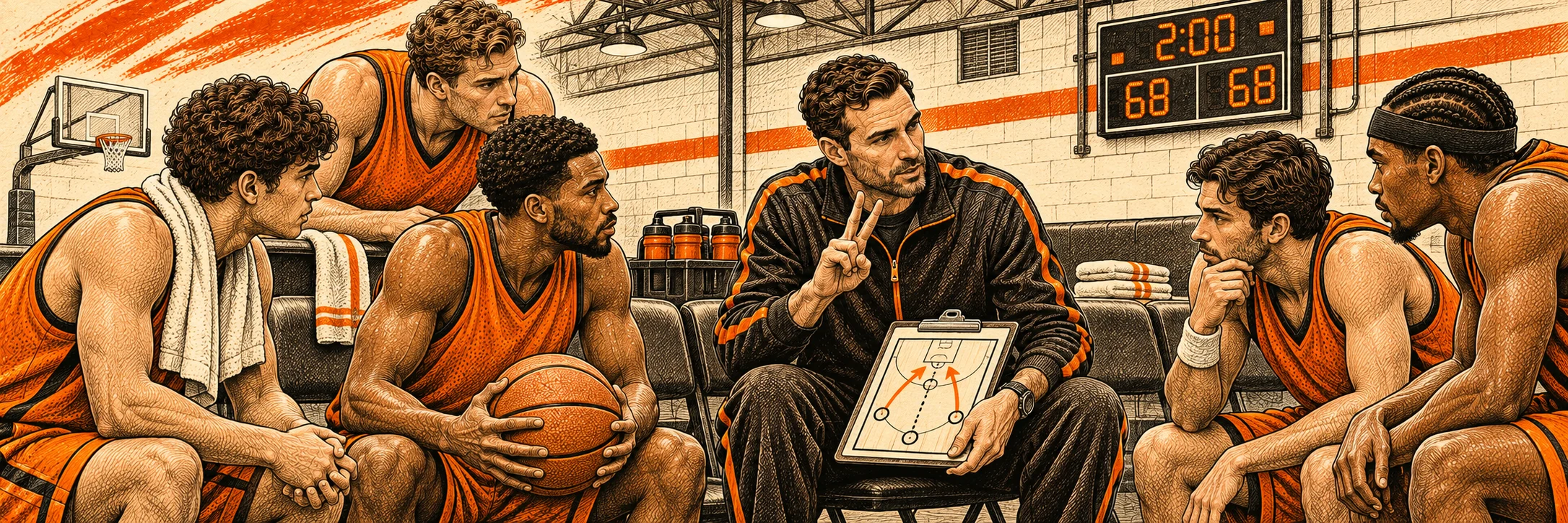
At Two Minutes: A New Ballgame, With the Same Scoreboard
“It's a new ballgame” captures the opportunity. It does not erase the score, foul counts, fatigue, or opponent's ability.
It means that we have brought the contest into a short stretch in which a few possessions can decide the outcome. Now we need the people and preparation to execute them.
I want three resources available: players who can perform their roles, timeouts I am legally allowed to retain, and closing situations the team has rehearsed.
I want my main players physically ready and available, with avoidable fouls kept off their records. Injuries cannot be guaranteed away. Conditioning, sensible rotations, medical judgment, and attention to fatigue help us manage readiness.
Before the next possession, the players must know the score, the clocks, the foul situation, and the action we want. Who receives the inbound? Where is the second outlet? What happens if the first option is denied? Who handles the ball if the opponent fouls? What shot are we prepared to concede, and what shot must we take away?
If we lead, ball security and a good shot may matter more than forcing another quick score. If we trail and time is running out, we may need to increase possessions. The plan that kept the game close must adapt to the current score and clock.
Match the Strategy to Your Rulebook
The available clock and foul budget change the plan. FIBA uses four 10 minute quarters and a 24 second shot clock. The NBA uses four 12 minute quarters with 24 seconds. NCAA men play two 20 minute halves; NCAA women play four 10 minute quarters. Both college games use 30 seconds.
An ordinary foul limit is five in FIBA and NCAA basketball, and six personal fouls in the NBA. A personal foul stays with the player across the game. The ordinary team bonus works differently: FIBA and NCAA women reset team fouls each quarter and award two free throws on qualifying defensive fouls from the fifth. NCAA men use a one and one from the seventh team foul of a half and two shots from the tenth. The NBA also has a quarter based penalty, with a special final two minute provision. [1][3][4][5][6][7]
That distinction matters when we attack a key defender. An early personal foul remains a problem for that player. The team bonus benefit lasts only within the relevant period. Never assume that drawing fouls in one quarter buys a bonus in the next.
After a made basket late in regulation or overtime, the clock stops at 2:00 or less in FIBA and the NBA. In NCAA men and women, that automatic stoppage begins in the final 59.9 seconds of the final regulation period or overtime. Your players must know how much time a normal inbound will consume. [1][2][6][7]
The timeout budget, who may request one, and when it can advance the ball belong in a separate preparation plan. Read Timeouts: Know When to Stop, Know When to Play for the FIBA, NBA, and NCAA comparison and the work inside the huddle.
High school coaches must check their state association's shot clock and competition rules before applying a college closing sequence.
Practice the Game You Want to Reach
Build practice around three situations that connect the strategy to actual decisions. Before each segment, assign one or two teaching points. Watch for those points, correct the breakdown, and replay the situation.
1. Control the Opening
Start with eight minutes on the game clock and use the shot clock for your competition. Give the opponent a clear matchup advantage and instruct it to pressure the ball and push after stops.
Our two priorities are ball security and an organized attack that creates a paint touch or another clear advantage. Take an open finish. Reject a rushed attempt that gives the opponent the game it wants. Review the shots created, the live ball turnovers, and the transition opportunities conceded.
2. Attack the Foul Matchup
Assign an opposing interior defender a realistic foul count for the stage of the game. Play live possessions with the defense free to adjust and the official applying normal contact rules.
Our priorities are involving that defender in the action and reading the help. Credit the correct finish or pass even when no foul occurs. Correct drives into established legal position. We are teaching players to create a scoring problem that can also create foul pressure.
3. Play the Final Two Minutes
Start two points down with 2:00 remaining. Specify personal fouls, team fouls, timeouts, possession, and the applicable rules before play begins. Use a different score and resource situation in the next round.
Coach one offensive priority and one defensive priority. For example, create a clean inbound with a second outlet, and finish the defensive possession with a rebound. Reset after a wrong decision, explain the read, and play it again. Assess the decision as well as the result.
The team must learn to recognize the situation while it is moving. Players who can execute a diagram but cannot identify the score, clock, and defensive response are still unprepared for the possession.
Give Your Team a Chance to Beat Better Teams
Beating weaker opponents is part of the job. Winning at home is part of the job too. I want my teams prepared to challenge stronger opponents in their gym.
That requires a plan extending beyond the opening minutes. Establish a sustainable pace. Make the opponent defend meaningful actions. Protect our players and possessions. Adapt before the game gets away. Arrive at the closing stretch with enough resources to act.
When the final two minutes begin, I want my players to recognize a situation they have prepared to win.
Rules and Further Reading
Rules checked November 6, 2026. The possession calculation above is illustrative. For the timeout rules and huddle, see the separate timeout article.
[1] FIBA Official Basketball Rules 2026, version 1.1. Official FIBA document, Articles 8, 29, 41, 42, and 50. In force October 1, 2026.
[2] NBA Rule 5: Scoring and Timing, Sections II, V, and VI.
[4] NBA Rule 3: Players, Substitutes and Coaches, Section I.
[5] NBA Rule 12: Fouls and Penalties, Part B, Section V.
[6] NCAA 2026/27 Major Basketball Rules Differences, bonus, format, foul limit, and advancement comparisons.
[7] NCAA Men's Basketball 2026/27 Table Crew Reference Sheet, clock and shot clock provisions.
Coach the Momentum Until the Final Buzzer
The lead tells us the current score. The possessions tell us who is dictating the game. We can be ahead while surrendering control, or behind while taking it back. The score still sets our urgency and risk. At the final buzzer, it decides the result.
A substitution, a practiced defensive change, a different offensive entry, better floor balance, or a change of tempo may address the problem before a timeout is needed. Identify what is feeding the run, choose the response, and check the next possessions.
Explore the decisions in Substitutions: Change the Game, Not Just the Lineup and Change the Defense With a Purpose.