A team wins the shooting contest and celebrates. Then I give them the other score: together, both teams made 12 of 24 free throws. Somebody won the drill. We still missed half our shots.
That is why I keep track. The final score tells us who won. It does not tell us whether the work was good enough, where a possession broke down, or what we should change tomorrow.
Coaches will spend hours gathering information about an opponent and still have no clear record of what their own team does in practice. Start with the team you can actually improve.
Measure a Coaching Question
Before choosing a statistic, write the question. Are we getting a shot in advantage situations? Are we completing the defensive possession? Are our passes arriving while the receiver still has an advantage?
“We need to concentrate” gives players very little to act on. “We failed to get a shot on four of ten advantage possessions” identifies something we can inspect. Film can then show whether the problem was the first pass, the receiver's preparation, or a ballhandler who drove into help after the passing window had closed.
Use three steps: define the action, record it consistently, and coach the cause. A count without a definition becomes an argument. A count without a correction becomes paperwork.
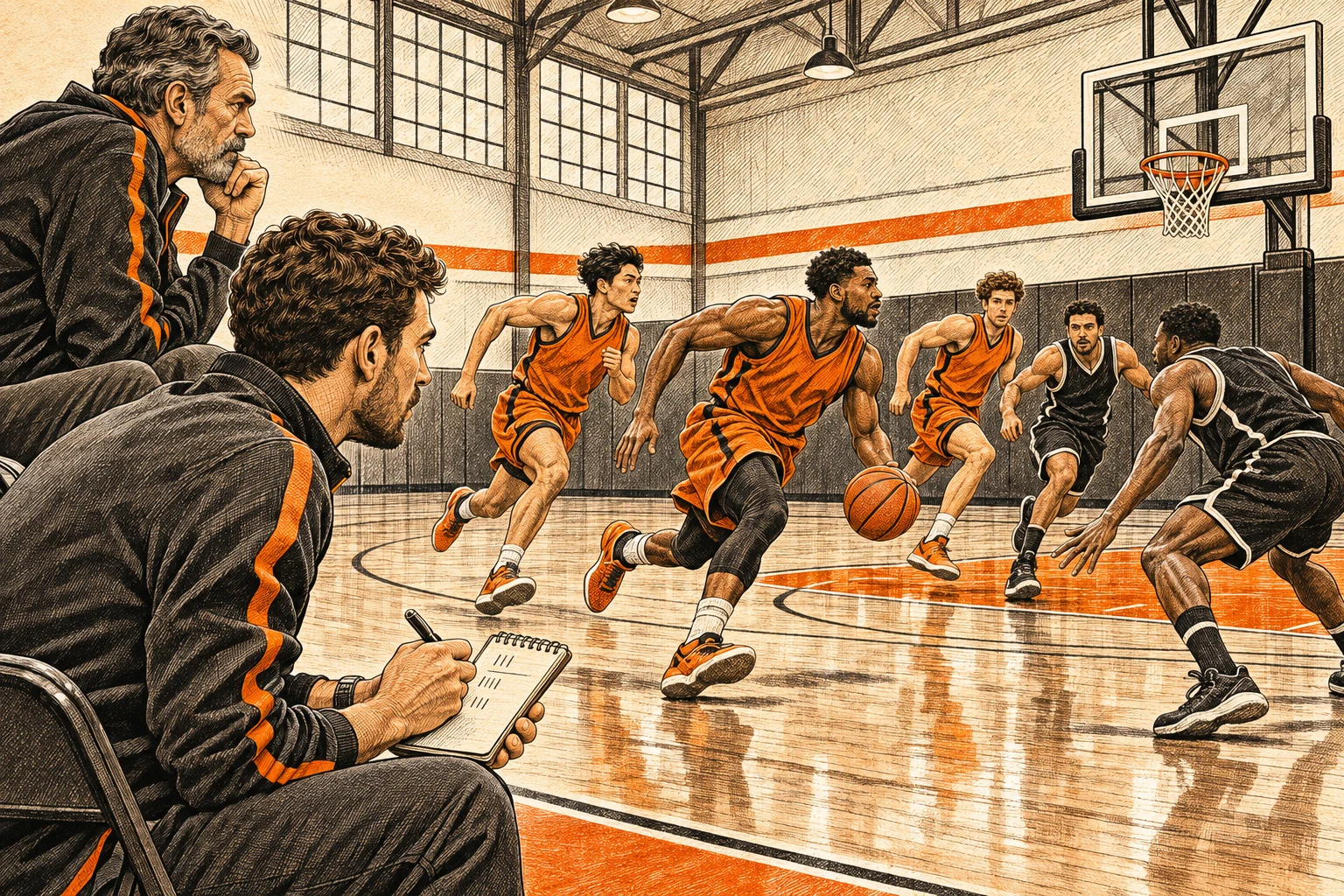
Choose one or two priorities for the session. A single assistant can track them while you coach. Without an assistant, use a short observation block, review the film afterward, or give an appropriate recording job to someone who understands the definitions. Do not let the recording task pull an active player out of the work.
Count What Happens Before the Result
In a three on two drill, a made layup can hide a late pass. A missed layup can follow the correct read and an accurate delivery. Record the outcome, then examine how the group created it.
For ten possessions, mark whether the offense reached a shot, whether it created the intended advantage, and where a turnover began. Keep a live ball turnover separate from a violation. Losing a pass to a defender and traveling on the catch may require different corrections.
Be precise about the denominator. “Four turnovers” means little without knowing whether the group had ten possessions or forty. For a controlled drill, count the actual possessions. When reviewing games, use one consistent possession definition or the official data available to your staff.
An offensive rebound continues the same team possession for this purpose. If you also want to count separate shot opportunities, label that measure separately. Otherwise, two staff members can watch the same sequence and produce incompatible totals.
Three Useful Practice Checks
1. Free Throws: Keep the Team Total
Run the competition, but keep makes and attempts for everyone. The winning group still needs an honest picture of its shooting. Record the conditions too. A rested shooting block and free throws after demanding live play ask different questions.
Use the result to choose the next assignment. If the same player repeatedly changes the routine under pressure, coach the routine. If fatigue affects balance, look at the base and the workload. Do not diagnose either problem from one miss.
2. Advantage Play: Did We Reach a Shot?
In three on two, count possessions that end without a shot. Then review the read. Did the ballhandler engage a defender before passing? Did the receiver present a target? Did the third player hold useful spacing or crowd the drive?
Keep the drill's main teaching point visible. If you are working on pass timing, do not bury that priority beneath six unrelated categories. After the correction, repeat the same problem against live defenders and see whether the behavior changes.
3. Shooting: Keep the Conditions Comparable
Track sets of ten with the location, shot type, and pace of the drill. A stationary catch at the elbow is different from a sprint into a contested catch. Comparing the percentages without that context tells the player very little.
For individual development, compare the player with their own previous work under comparable conditions. Growth, role, and physical development differ across a roster. A teammate's result does not tell you whether this player's practice plan is working.
Read the Possession Behind the Box Score
Two missed threes can have very different meanings. One comes with an open window early in the possession. The other is a forced release as the shot clock expires. Both register as misses. The coaching question is how each situation developed.
A turnover also needs context. The passer may deliver late. The receiver may stop a cut without reading the defense. A third player may bring help into the passing lane. Keep the official scoring intact, then use your review notes to identify the sequence that needs work.
That distinction matters when judging a pass that becomes an assist or a turnover. Reward a sound decision even when the finish fails. Correct a poor decision even when the ball happens to reach its target. Players learn very quickly what the coach actually rewards.
Watch the actions that standard totals miss: the screen that frees the shooter, the relocation that opens a driving lane, the early call that prevents a layup. Define a small number of these actions clearly enough that your staff can recognize the same event.
Do not turn every positive movement into an invented point system. A teaching measure earns its place when it helps you explain a job and decide what to practice.

Use Numbers to Check Momentum
An opponent makes two difficult jumpers and your bench feels the game slipping. Before changing everything, check the possessions. Did you give up clean paint touches? Lose the defensive glass? Turn the ball over before organizing?
The score and the direction of play can tell different stories for a short stretch. The team leading may be losing control of the next few possessions. Treat that as a reason to inspect the floor, not as proof that a run will continue.
Choose the response that fits the cause. Repeated unblocked rebounders need a rebounding assignment. A trapped guard needs a release option. A substitution, a coverage change, or a timeout can help, but none replaces identifying the actual problem.
Avoid judging a lineup from a few makes and misses. Short stretches are noisy. Use them to form a question, check the film, and look for the same pattern across more possessions. A number should challenge your impression as readily as it confirms it.
Turn the Review Into the Next Practice
Bring the players a short sequence and a clear count. Show the successful execution as well as the breakdown. Name the cue they should recognize and the action you want earlier.
For example: “On four of ten possessions we never reached a shot. On these two, the wing stayed below the passing angle. Today we will work on opening that angle as the ballhandler engages the second defender.”
Then practice it. Use the same definition to check the next block. The purpose is to see whether the correction survives live play, not to manufacture a better looking total by making the task easier.
This is the difference between reviewing performance and labeling a player. “You are careless” closes the discussion around a person. A late delivery, an unprepared catch, or a missed rotation gives us work we can do.
Keep the record simple enough to maintain. Give each number a basketball meaning. When the review changes the next practice, measurement has done its job.