A player keeps the dribble alive but misses every cue. Another names every symbol correctly while the ball gets away. Neither performance tells the whole story.
When I combine a cognitive task with movement, I want to see what happens to both. The useful question is whether the player can keep the physical action organized while processing information that matters.
Establish two baselines
Start with the movement on its own. Use a task the athlete understands, such as maintaining a controlled dribble while moving between two court lines. Record ball losses, balance, and completion quality.
Then check the cue rule without the moving dribble. Can the player identify each symbol and perform its assigned response? A misunderstood rule is a teaching problem before it becomes a reaction challenge.
Keep both results visible
Combine the same movement and cue rule. Record correct responses and movement errors separately. A faster answer is less useful if it produces a lost ball. A clean dribble with no correct decisions misses the purpose too.
Compare each result with its own baseline. Less completion time may be better; more correct responses may be better. Do not combine unlike measures into a single score that hides the tradeoff.
Change one source of difficulty
Cognitive demand can change through the number of responses, cue timing, memory requirements, or a rule change. Movement demand can change through pace, direction, ball control, or defensive pressure.
Raise one demand while keeping the other stable. If you increase running speed, shorten the cue interval, and add a defender at once, it becomes difficult to see what the player needs to learn next.
A practical three block progression
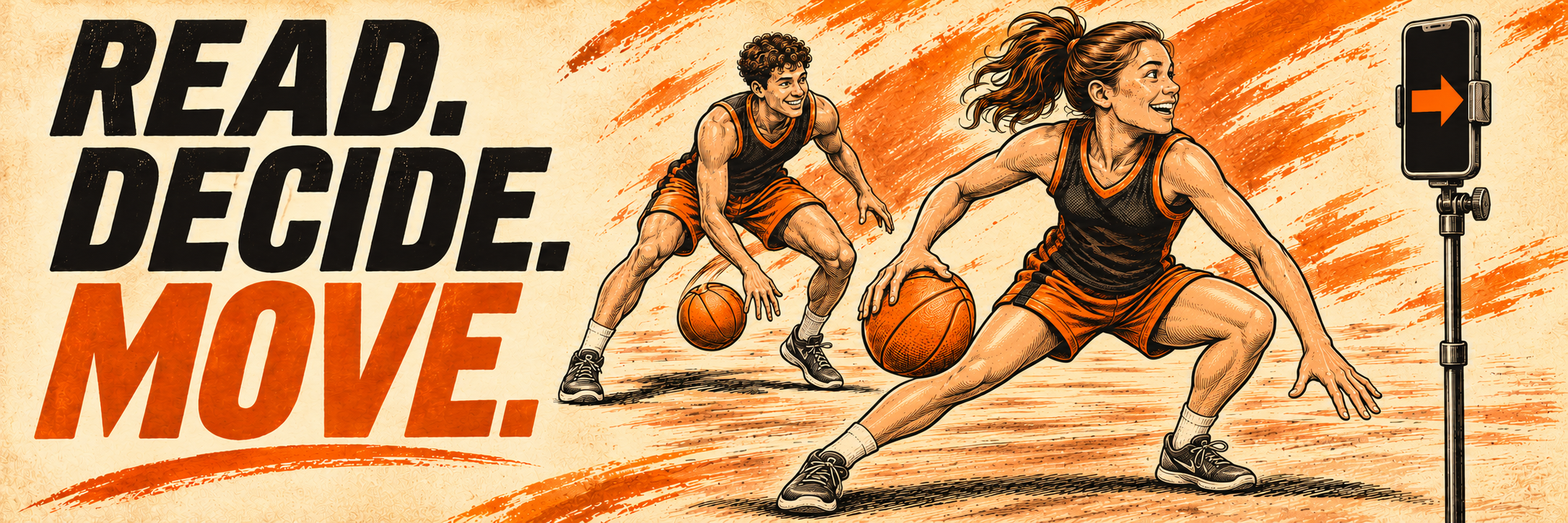
Block one: use a familiar dribble at a manageable pace and two visual choices. Each arrow indicates a direction with room to move safely. Show one symbol at a time.
Block two: keep the same movement and pace but introduce a third known response, such as stopping under control. Confirm the rule before restarting.
Block three: return to the original two choices and increase the movement demand slightly. Compare the quality with block one. These are coaching examples, not a research validated dosage for REACT CRT.
Simplify when the task stops teaching
If the athlete repeatedly guesses, stops reading, or abandons the movement, give more time, reduce the choices, or briefly return to the movement alone.
Visible struggle is useful when it reveals a problem the player can work on. A challenge without a recognizable success standard gives the coach little information.
Finish with basketball information
REACT CRT lets me control the visual rule and vary the next cue. A teammate and defender then supply the information that belongs to the game.
Finish with a live task using the same movement. Ask the athlete to identify defensive position and an available passing window. Observe whether the skill remains available when the symbol is gone.
Record the task, rule, settings, correct decisions, and movement errors. Progress when both demands remain controlled. The goal is a player who can think while moving and keep moving while thinking.
Related practice from REACT CRT
“Make each day your masterpiece.”
For related scientific evidence, see Cognitive Reaction Training: What the Research Supports.