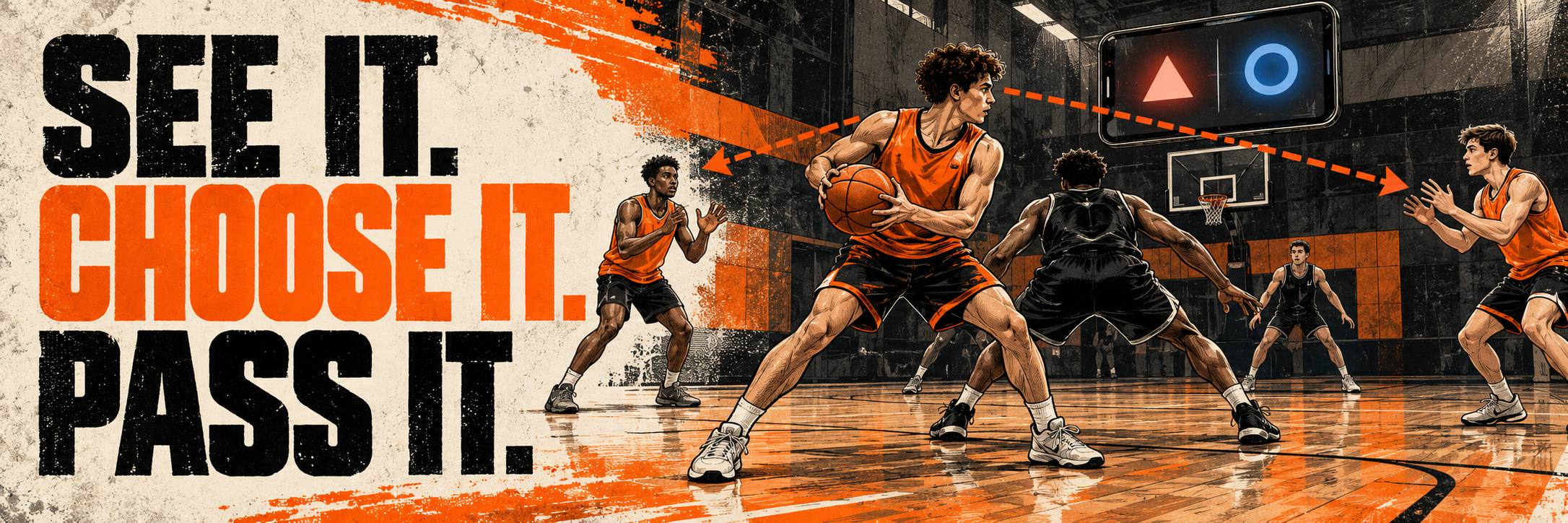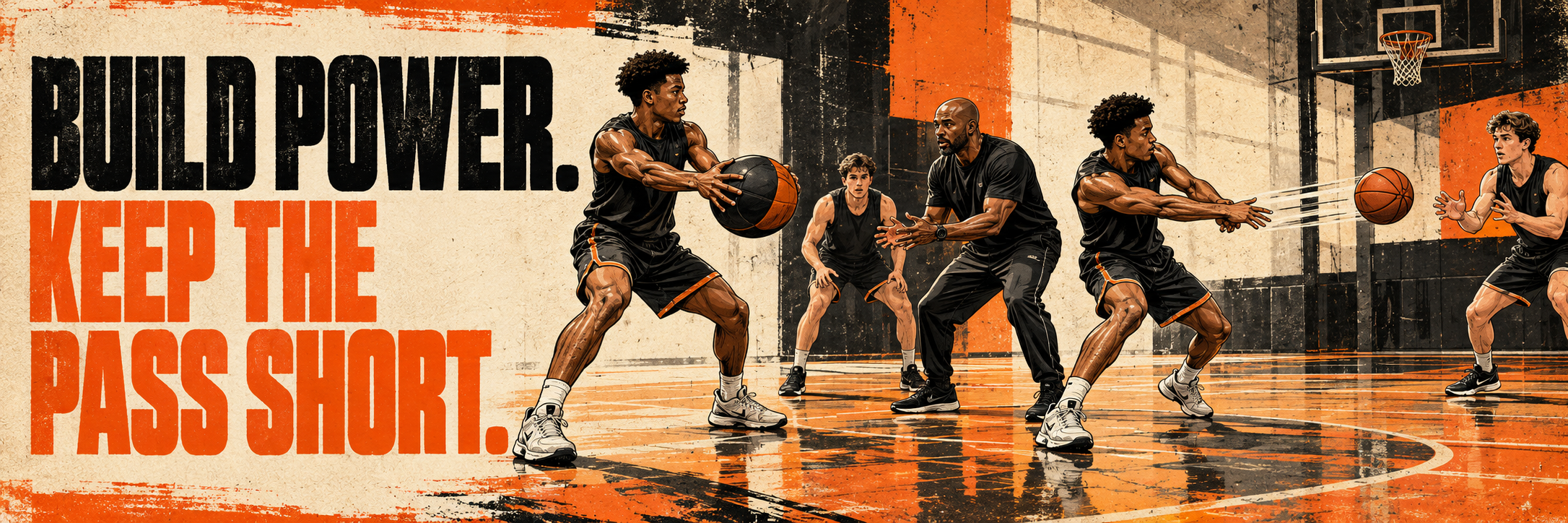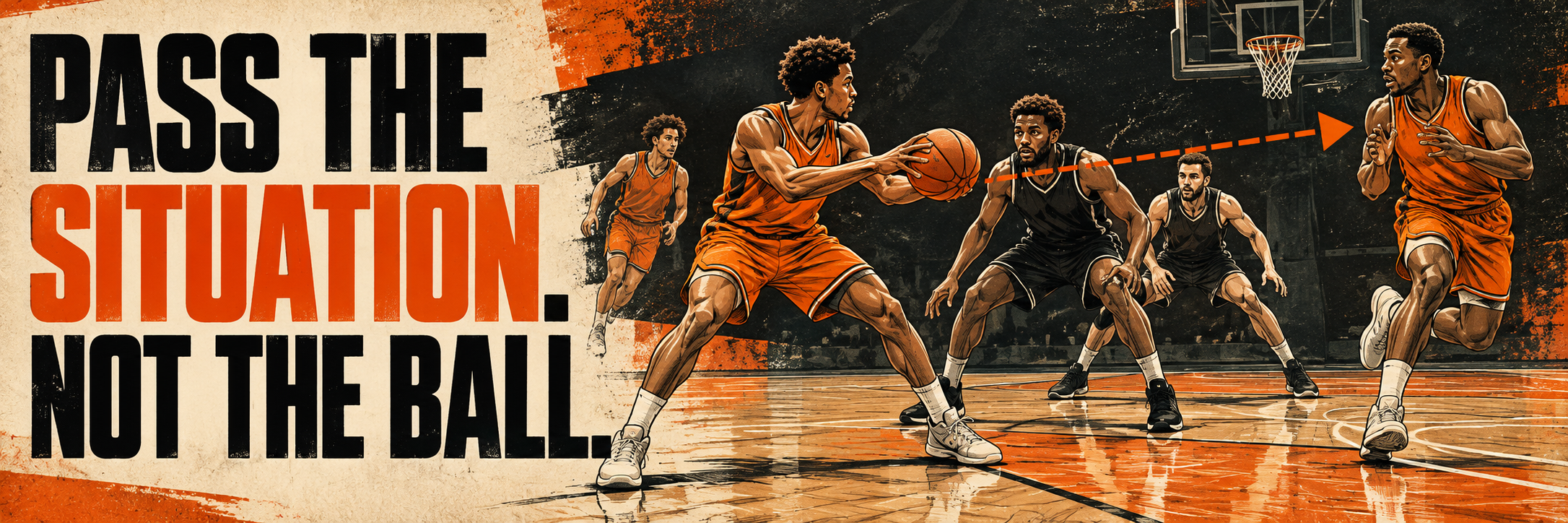
How many types of passes can you name?
That is how I usually open a coaching session on passing. The first answers are predictable: chest pass, bounce pass, overhead pass, and one hand pass. Give the room another minute, and the list grows.
The possibilities are almost endless. Different release points, angles, distances, speeds, and situations call for different solutions.
But collecting more passing techniques is not the goal. Teaching players to deliver the right pass, at the right moment, is.
The purpose of a pass
Coaches often demand hard, sharp passes. Sometimes that is exactly what the play needs. Sometimes it is the reason the play breaks down.
A pass can be fast and still be wrong.
The purpose is to transfer the ball as accurately and effectively as the situation allows. That means adjusting to the defense, the distance, the receiver’s movement, and the receiver’s ability to handle the ball.
One situation calls for a firm pass through a narrow window. Another needs a soft delivery over a defender. Another needs a bounce.
Teach players to choose the pass the game requires.
Passing connects two players
Passing introduces a relationship that individual ballhandling and shooting do not require in the same way. Two players must coordinate their attention, timing, and movement.
I teach two basic rules:
With the ball, look toward the basket so you can see the floor.
Without the ball, keep the ball in sight so you are ready to receive it.
Establish a visual connection with your teammate, even if it lasts only a moment. The passer needs to recognize readiness. The receiver needs to recognize the opportunity.
That connection is one of the foundations of intelligent team basketball.
Both players own the result
A completed pass is a shared responsibility.
The passer must choose a delivery the receiver can handle. The receiver must get available, prepare to catch, and help the pass succeed.
We say this all the time. Our practice habits should reflect it.
If you coach the release but never coach the catch, you are teaching only half the action.
Timing makes the pass
A passing window does not stay open because your player finally noticed it.
The receiver moves. The defender recovers. The angle disappears.
Teach players to recognize when the opportunity exists and deliver while it is still there. Once the window closes, they need another solution.
A pass that would have created an advantage a moment ago can become a turnover now.
Develop touch
Some players deliver a ball that seems to settle straight into a teammate’s hands. That is touch.
Touch develops through repetition, attention, and patience. Players must learn to adjust force, height, placement, and trajectory.
Do not judge every repetition by whether the ball arrived. Watch what the receiver can do with it.
Can the receiver continue moving? Shoot without unnecessary adjustment? Attack immediately?
The quality of the delivery affects the quality of the next action.
Let the defense shape the pass
Players often focus on the teammate they want to reach and overlook the defender who can interrupt the delivery.
Start with the defender.
Where is the defender positioned? Which hand can reach the ball? Which angle is exposed? Where can the receiver protect the catch?
Deliver the ball away from the defense. This principle applies on the perimeter, in the post, in transition, and in the half court.
The defender’s position should guide the choice of pass and its placement.
Teach the catch
Receiving deserves direct instruction and regular practice.
Move toward the ball when the situation calls for it. Shorten the passing distance instead of waiting for the defense to close it.
Bring your chest toward the ball and establish a balanced receiving position.
Use your body to keep the defender away from the catch.
Receiving is an active part of the play. Coach it with the same attention you give the pass.
Build the connection throughout practice
Passing standards belong in every part of practice: warmups, shooting drills, skill work, and live play.
A careless feed during a shooting drill is still a careless pass. A receiver who waits passively during warmups is still rehearsing that habit.
Use those repetitions to develop coordination between passer and receiver. Demand attention to timing, placement, readiness, and the next action.
Give players a broad passing toolbox. Then teach them how to choose from it.
The goal is a team that can recognize an opportunity and connect before it disappears.
That is where passing becomes team basketball.
Watch: Passing with cognitive reaction training
In this drill from the REACT CRT channel, passing practice is combined with cognitive reaction training. Use it alongside the principles in this article, with attention to the connection between passer and receiver and the quality of each delivery.
Article 1 of the passing series. Written and developed by Coach Yoed Agmon.