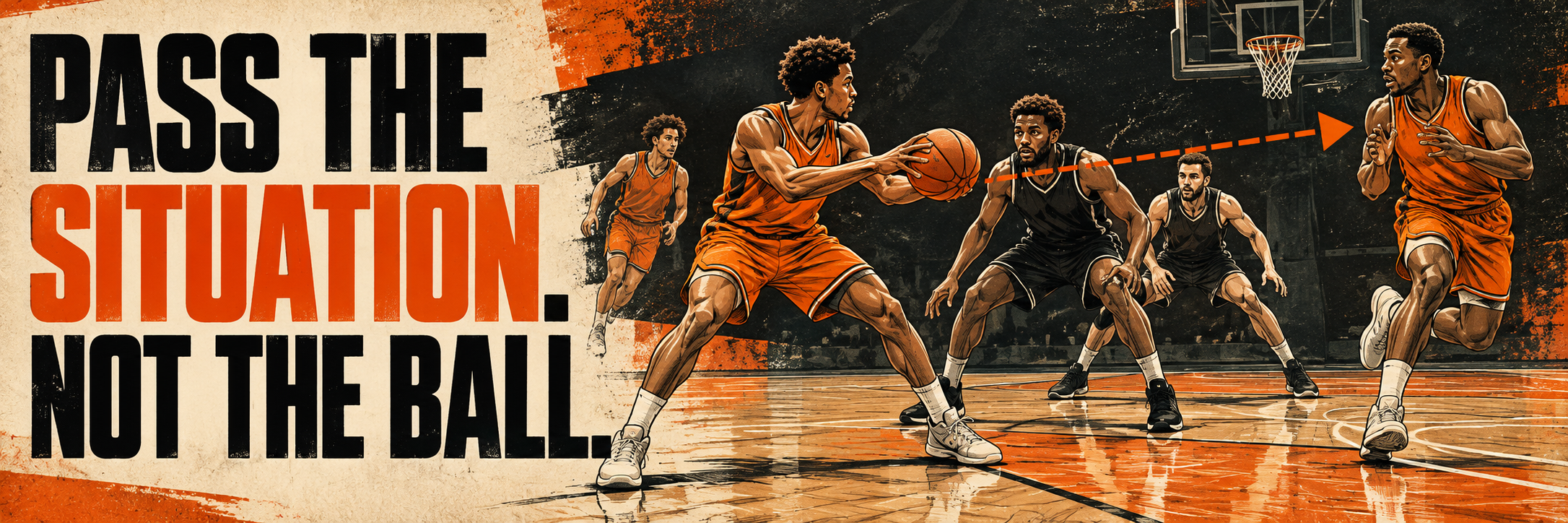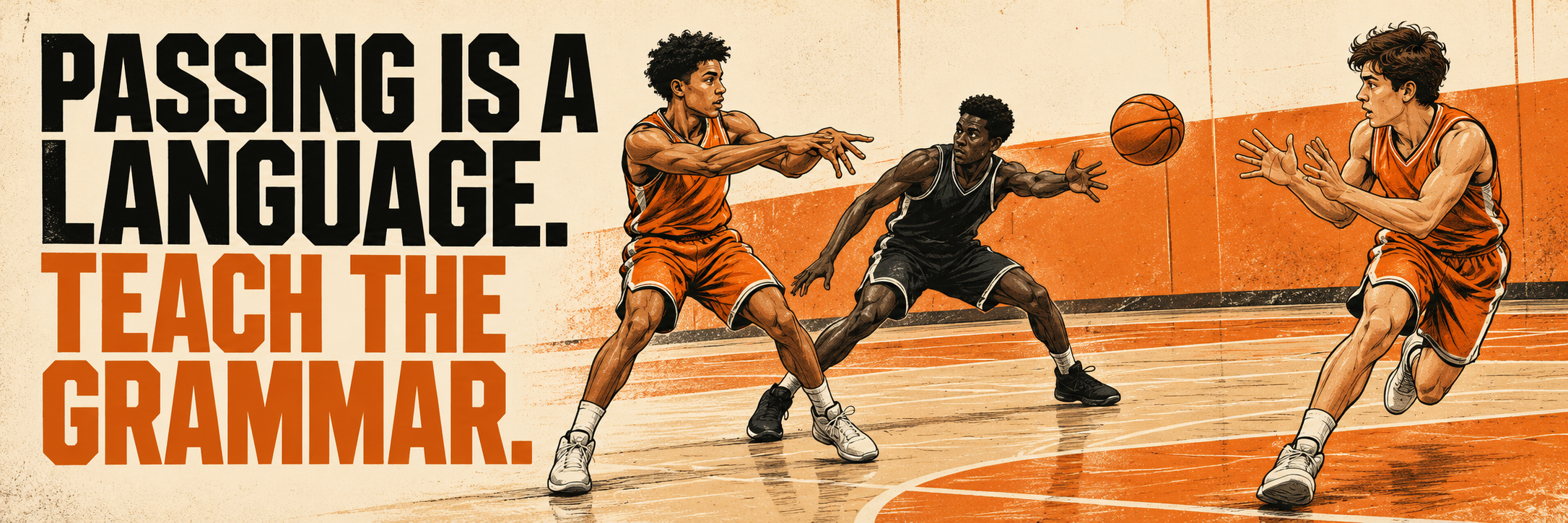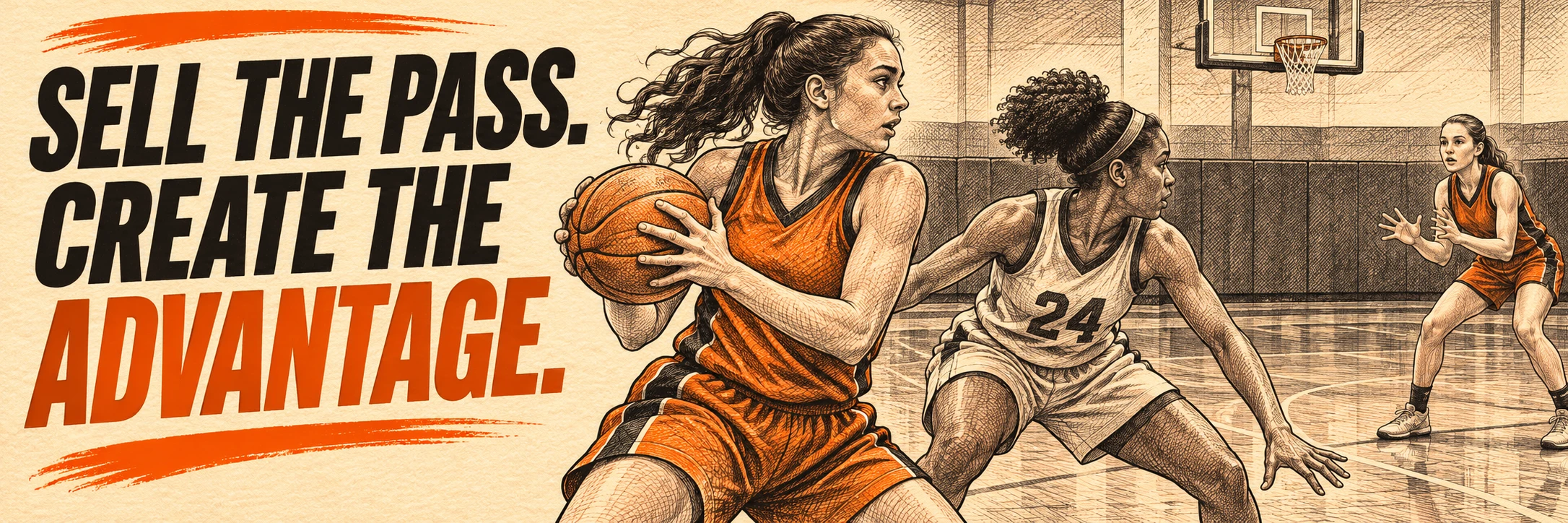
A fake presents one basketball action to create a defensive response that makes the next action available. You may shift a defender's weight, change the angle of the defender's body, move a hand, or send attention somewhere else. A small response can open a driving lane, a passing window, or enough room to shoot.
We can use fakes before starting the dribble, during a live dribble, and after gathering the ball. Shot, drive, and pass threats have different possibilities at each stage.
I want pass fakes to have a bigger place in player development. They can create a shot, a drive, or a different pass, and they can influence more than one defender in the same action.
Why the pass fake deserves more attention
A shot fake depends heavily on how seriously the defense respects my shooting. A drive fake depends on my ability to threaten penetration. The pass fake brings other players into the threat.
The defender must account for a corner shooter, a cutter behind the play, a player rolling to the rim, and options that cannot all remain in view at once. A believable passing threat may draw a response even when I am not an exceptional individual shooter or ballhandler.
That does not make every pass fake effective. Timing, context, and a plausible target still matter. The more credible threats the defense has to manage, the greater the opportunity to influence it by showing a pass.
1. Before the dribble: keep every option available
After receiving the ball, before I begin dribbling, I can shoot, pass, or attack off the dribble. A pass fake lets me influence the defense while keeping those options available.
Show the corner pass, then drive
Catch on the wing and present a pass to the corner. If the defender reaches toward that passing lane or changes stance, a driving lane may open. The advantage comes from the response. Be ready to attack as soon as the lane becomes available.
Show the pass, then shoot
The same passing threat can create a shooting opportunity. If the defender turns attention toward the receiver or lowers a hand to intercept the pass, use the opening.
Myles Turner provides a game example of a pass fake flowing into a perimeter shot. Study the immediate connection between presenting the pass and taking the shot. Watch Myles Turner on NBA.com ↗
Show the inside pass, then move the ball outside
Against a defense reacting to a possible entry pass, show the ball toward the post and observe how the help defenders shrink toward the paint. Their response may open a pass back outside or a reversal to the other side.
Show high, pass low
When a defender raises the hands to close a high passing lane, a bounce pass may become available. You can also present a low pass to change the position of the hands and open a lane above them.
These are decisions to read, not a fixed sequence to perform. Recognize which lane the defense closes and which lane the fake opens.
For a teaching demonstration of the pass fake into a drive, Detlef Schrempf shows the principle through Jr. NBA. Watch the Pass Fake and Drive demonstration ↗
2. During the dribble: deceive while keeping the ball live
Keep the distinction clear: a live dribble can continue; a completed gather cannot. Moving toward the basket does not keep the dribble alive. If the player gathers the ball, any subsequent fake belongs to the next stage.
Use the pass fake to present a believable option, then read what changes. A defender reaching, opening the hips, changing foot position, or transferring weight may give you an opening. Judge that response against the distance, the available space, and the help defense before choosing your next action.
Keep the fake legal
Keeping the dribbling hand above or beside the ball is a useful coaching cue. It is not the complete test of legality. Do not put the hand underneath the ball and carry it, or bring the ball to rest in the hand and then resume dribbling. Catching the ball with both hands also ends the dribble.
A play can contain a violation even when no whistle is blown. The absence of a call does not prove that a move is legal. Use game clips and tutorials to study the idea, then check the execution against the rules you play under. A YoYo dribble or fake pocket pass is legal only when its execution preserves a legal live dribble.
NBA dribbling rules ↗ · Official video example of an illegal discontinued dribble ↗
Use the hand that is not dribbling
Let the eyes, body, and free hand suggest a passing destination while the other hand keeps the dribble live. The passing signal should fit an option the defender believes could be real. A teammate's position, cut, and passing angle help sell that threat. A defender may also respond to a possible receiver outside the current field of view.
Watch for a hand moving toward the passing lane or a change in the defender's stance. Those movements are information, not automatic instructions to drive. Check which space is available and who can help. Luka Dončić and Tyrese Haliburton provide game examples in the video below.
Present the pass, then attack the opening
In Dončić's play against Portland, the pass fake is part of a sequence that ends with a dunk. The breakdown identifies a passing motion with his right hand while he continues dribbling with his left. Study the setup and continuation rather than copying the finish alone.
Recognize or anticipate the response and act while the opening remains available. Preparation, coordination, and timing matter alongside reaction speed. If the defender stays in position, keep another option. If a useful advantage is already there, use it without adding an unnecessary fake.
Show the pass to the player running beside you
In transition, a teammate running beside you can force a defender to choose between stopping the ball and protecting the pass. Present the passing threat when that teammate's route and the passing angle make it believable.
Read the defender's feet, hips, reach, and distance. A weight shift toward the heels may affect recovery, but it does not guarantee a driving lane. A turned head does not necessarily mean the defender has lost awareness of the ball. Continue, change direction, or pass according to the opening that actually exists.
Show the kickout from penetration
When help comes toward the ball, a passing signal toward a shooter may change the helper's position or timing. Check the shooter's spacing, the passing window, and the other defenders. If the helper starts recovering outside, the drive may remain available. If the helper stays with the ball, the actual pass may be open.
Keep the ball live while making the read. Do not gather just to sell a pass if you still need the dribble. Look for a usable change in the defense, not simply a visible reaction.
Chris Paul: between the legs pass fake against Memphis
Paul presents a pass between his legs and continues the attack against Memphis. Study the timing of the passing threat within the dribble sequence. Assess the ball control separately: the lack of a whistle is not a legal ruling on every part of the action.
Chris Paul: the YoYo dribble pass fake
This teaching breakdown shows the ball suggesting a pass before returning to the ballhandler. Sell the destination without supporting or carrying the ball from underneath. Keep the dribble legal and have the next action ready.
Watch whether the defender commits a hand or changes position. Use the opening while it lasts. Do not add the action if it delays a drive or pass that was already available.
Chris Paul: fake pocket pass
Present the threat of a pocket pass to a teammate moving inside while keeping the dribble live. The roll, spacing, and passing angle should give the defender a credible problem to solve.
Read whether the defender moves toward the receiver, stays with the ball, or recovers between both. Continue only through space that is actually available. Check that the ball never rests in the hand before the dribble resumes.
John Wall: cut dribble and YoYo pass fake
This teaching demonstration explores a cut dribble and YoYo action as a passing threat. Use it to study the idea and coordination. Check hand position and ball control throughout; a tutorial is not proof of legal execution.
Connect the fake to a live decision. Give the player a teammate and a defender, then allow a real pass or a continuation. The goal is to preserve options and exploit the response, not complete a predetermined move.
3. After the gather: use the passing threat to create the finish
After gathering the ball, the player cannot start another dribble. The available options are passing, shooting, and legal footwork. The pass fake must fit those options.
This is where many of the most memorable plays happen. The attacker is already moving toward the basket, the defense prepares to contest, and the passing threat changes the response at the last moment.
Rajon Rondo: show behind the back, finish yourself
Rondo presents a pass behind his back on the way to the basket, keeps the ball, and finishes. The passing threat brings another possible receiver into the defender's decision while Rondo stays ready to complete his own finish.
Rondo against Atlanta: the same principle in another play
Against Atlanta, Rondo again shows a pass behind his back before finishing. Watch Rondo against Atlanta on NBA.com ↗
Jason Williams: build the passing threat into the finish
Jason Williams also uses a pass fake behind the back before a finish against Golden State. It is another example of a passing action becoming a tool to create an individual scoring opportunity.
Stephen Curry: show the pass in the air
Curry presents a pass in the air and finishes with a reverse layup. The ball is already gathered and the player is airborne. The example shows the potential of the passing threat very close to the rim. It is an advanced execution requiring strong body and ball control.
Manu Ginóbili: use the pass fake to create a jumper
Ginóbili presents a pass against Kevin Garnett and follows it with a fadeaway. The pass fake can also create the space needed to shoot.
Chris Paul: connect the pass fake to the shot
Against Denver, Paul combines a pass fake with a midrange jumper. Study how the passing action connects to the shooting preparation and how little time the defense has to respond again.
Ginóbili: show one pass, deliver another
A pass fake can also prepare a real pass. In this play, Ginóbili presents one option before delivering the ball to Aron Baynes for the finish. Watch Ginóbili fake and dish on NBA.com ↗
What should we learn from these plays?
Start watching before the highlight. Where are the other players? What passing threat is being presented? What choice does it give the defender?
Then identify the response. Did the defender look away, move a hand, change direction, or leave a position? Finally, see how the ballhandler used that change.
The same pass fake can lead to different answers. Drive when a lane opens. Shoot when space appears. Pass when the defense stays with the ball and the receiver is available.
My recommendation: make pass fakes a regular part of practice
Train pass fakes in all three stages: before the dribble, during a live dribble, and after the gather. Include moving teammates and a defense that makes the player choose how to continue.
Set one or two teaching points for each practice task. Start with a believable threat and a timely response. Later, focus on keeping the dribble live or fitting the fake into the footwork of the finish.
Do not demand a fake on every possession. Use the advantage when it is already available. When the defense closes the action you want, a pass fake can change the picture.
The value is in making the defense respond to one possibility, then executing the action that response makes available.
Keep building the passing game
Continue with passing fundamentals, passing as communication, and the decision behind an assist or a turnover. Use clear coaching cues and error correction to turn the idea into a focused practice task.
“Make each day your masterpiece.”