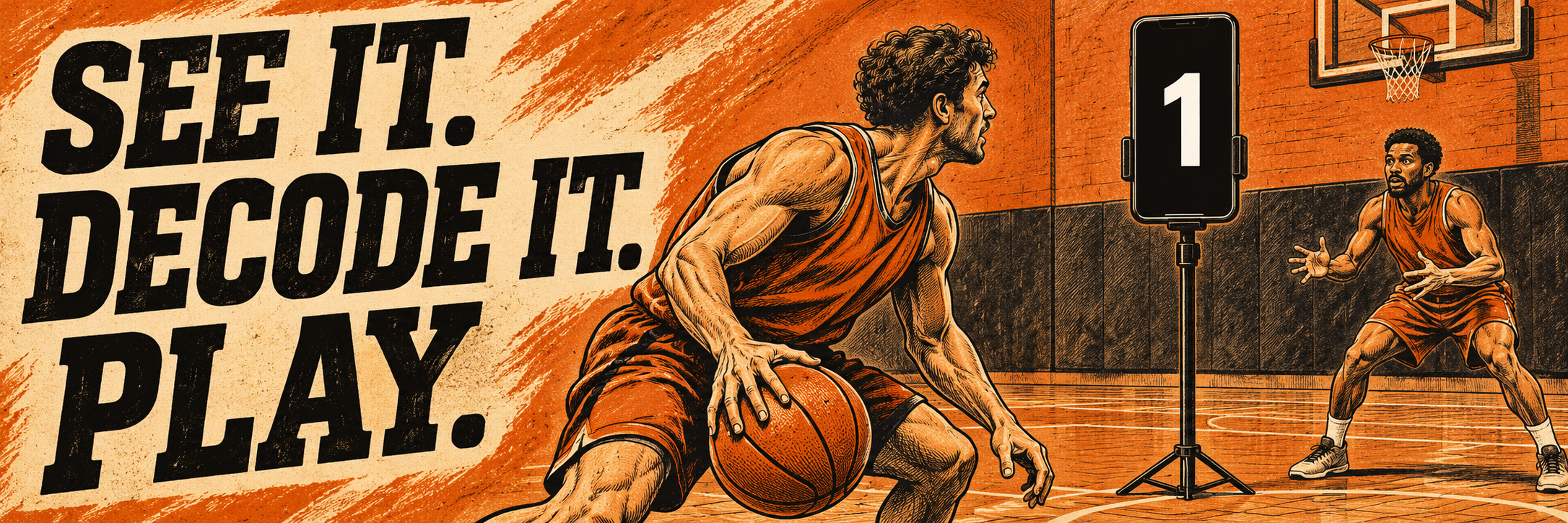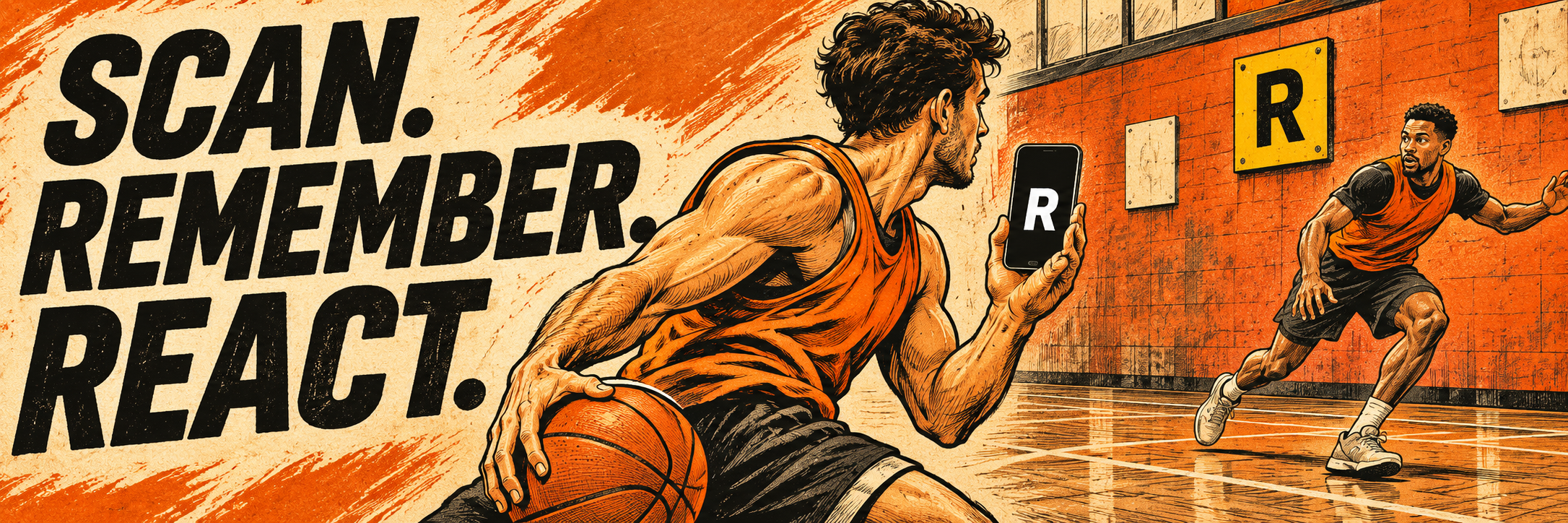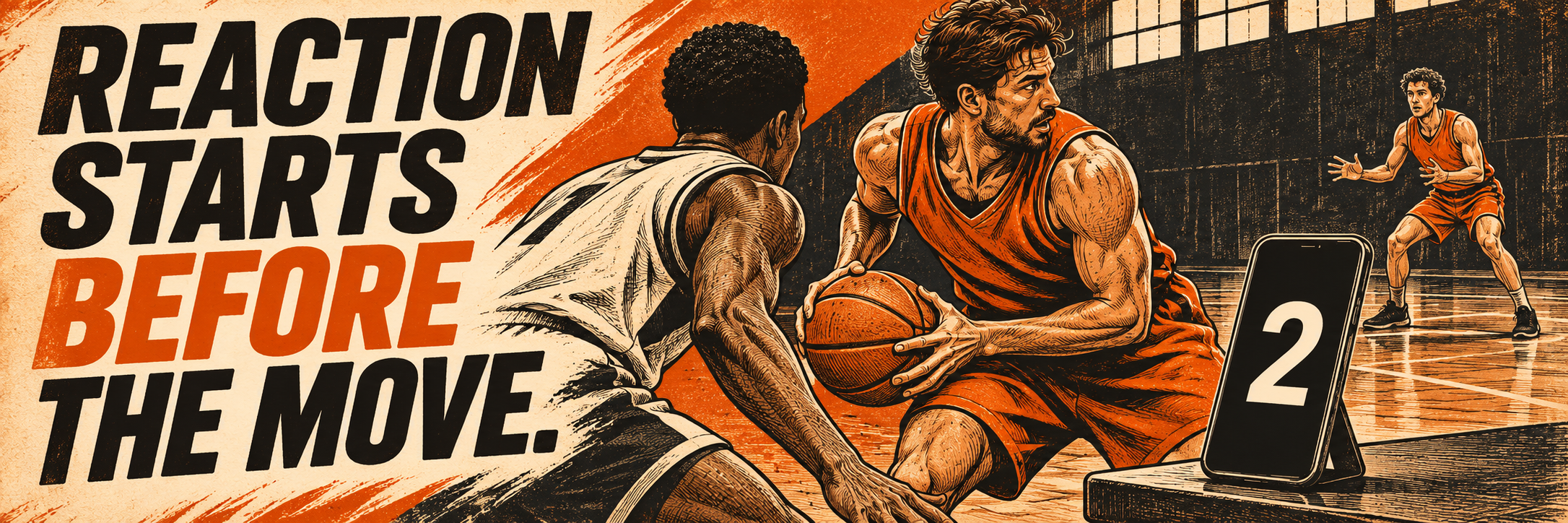
A player sees the opening late, hesitates, and loses the chance. The movement looks slow. But where did the delay begin?
In my coaching framework, reaction is a process. It starts before the body moves and continues until the player produces an accurate action.
In WONDROUS WORLDS, I describe five connected components: awareness, cognitive interpretation, emotional coping, physical ability, and quick, precise execution.
Look at the whole process before deciding what to correct.
1. Awareness: Notice what matters
The player must first pick up relevant information. Where is the ball? Where is the defender? What has changed in the space?
A player who misses the cue cannot make use of an excellent physical response. Train attention as part of the skill. Ask players what they noticed before you tell them which movement to use.
In REACT CRT practice, a visual symbol provides a changing cue. On the court, the information comes from players, space, and the developing possession.
2. Interpretation: Give the cue meaning
Seeing a cue is different from understanding it.
The player must recognize the information, connect it to an agreed rule or a game situation, and retrieve a useful response. Recognition, memory, context, and recall all have a place in that process.
That is why I want practice to include something the player must work out. A movement performed beautifully on command still needs to become available at the right moment.
3. Emotional coping: Stay available to the next action
Frustration, fear, and uncertainty can affect how a player responds.
A mistake may pull attention away from the next cue. Pressure may lead the player to rush, freeze, or choose the most familiar action without reading the situation.
Coach the response to difficulty inside the practice. Give a clear correction, then return the player’s attention to the next task. The goal is to keep the player engaged in the action that is available now.
4. Physical ability: Make the decision executable
The body must be able to carry out the choice.
Strength, coordination, balance, and control of movement matter. So do the ability to brake, shift the center of mass, and redirect force.
Keep developing those qualities. Cognitive work does not remove the need for physical preparation. My approach connects the demands so the player can use them together.
5. Execution: Finish with speed and precision
A quick start does not complete the job. The pass has to reach a useful location. The stop has to leave the player balanced. The change of direction has to fit the space.
Watch what happens after the first movement. Is the player still organized? Can the next action begin?
Measure the quality of the response as well as its speed. An incorrect action performed faster is still an incorrect action.
Find the limiting step
As a practical coaching application, use a familiar basketball movement with two clearly defined visual cues. Begin at a pace the player can manage.
When a repetition breaks down, ask where the process failed. Did the player miss the cue, misunderstand it, lose focus after an error, struggle physically, or execute inaccurately?
Change the part of the task that addresses that problem. Do not automatically make the cue faster or prescribe more repetitions.
The objective is a useful response: notice, understand, stay composed, move, and finish accurately.
Watch a related practice
Related CRT practice: visual information and movement. This video is from the REACT CRT channel. Use it alongside the coaching principles above; it is a related practice example rather than a demonstration of every detail in the article.
Written and developed by Coach Yoed Agmon. Adapted from his original Hebrew article, with practical basketball applications.