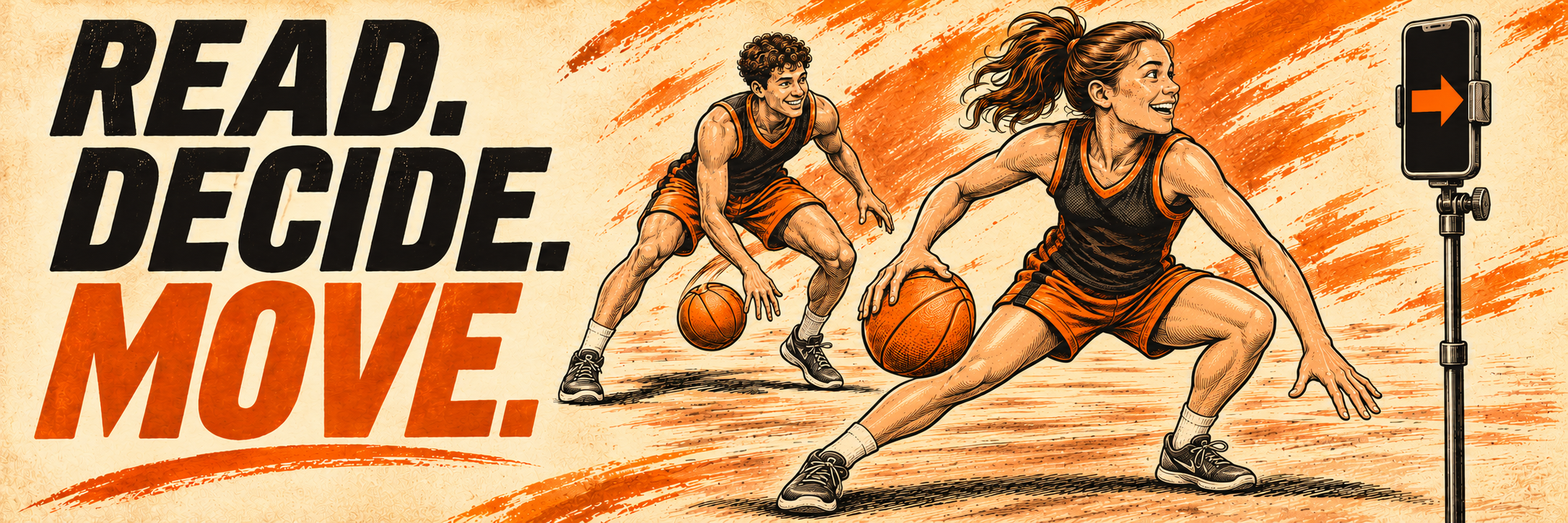
Can combining a thinking demand with a movement task help a basketball player? The literature gives coaches reasons to investigate it and clear reasons to measure the result carefully.
This is a focused coaching roundup of six publications, not a new systematic review. Research on related protocols informs training design; it does not automatically validate the REACT CRT app or kit. Reviewed November 3, 2026.
Six publications at a glance
| Publication | Design and scope | Finding and interpretation |
|---|---|---|
| Lucia, Bianco & Di Russo, 2023 | Randomized controlled trial 52 adolescent players, five weeks | Combined dribbling and cognitive practice improved tested basketball and cognitive outcomes more than standard motor training. |
| Lucia et al., 2023 | Controlled intervention 30 elite basketball players, five weeks | The experimental cognitive and physical training group improved sprint, agility, and decision response tests. |
| Lucia et al., 2024 | Controlled intervention 30 skilled basketball players, five weeks | The experimental circuit group improved sprint and agility completion times; motor preparation and response time also changed. |
| Zhu et al., 2024 | Systematic review and meta analysis 22 quantitative studies across team sports | Laboratory gains were larger than on court transfer effects. Outcomes and methods differed across studies. |
| Li et al., 2026 | Basketball specific systematic review 14 reports, 11 independent cohorts | Benefits were concentrated in trained or related tasks; consistent match transfer and lasting learning were not established. |
| Fransen, 2024 | Critical opinion Conceptual evaluation of near and far transfer | Warns against treating generic task gains as proven sport performance gains. This is a commentary rather than a trial. |
Reading the basketball trials
The randomized trial with 52 adolescent basketball players included 28 girls and compared five weeks of combined dribbling and cognitive tasks with standard motor practice. Benefits concerned measured dribbling and cognitive outcomes, rather than competitive match performance.
Two further papers studied cognitive demands inside physical circuits with groups of 30 basketball players. Their related authorship and settings should not be mistaken for a large, independently replicated evidence base. Participant totals should not be added without checking for overlapping cohorts.
What the recent basketball review adds
The September 2026 review identified 14 reports but only 11 unique participant cohorts. That distinction matters: another report is not necessarily another independent experiment.
Its most consistent favorable findings concerned the integration of cognitive control and basketball relevant movement. However, retention tests and representative game or competitive match outcomes were uncommon and did not show consistent intervention specific benefits.
The review does not establish generalized improvement in basketball decision making or lasting transfer to competitive performance. That limits the claims the evidence supports; it does not establish that transfer can never occur.
Laboratory progress and basketball progress differ
The 2024 team sport meta analysis reported a larger effect for laboratory performance than for its on court transfer measures. The reported standardized effect sizes were 1.51 and 0.65 respectively. These are not percentage improvements or promised gains for an individual athlete.
Fransen’s critical opinion article explains why a gain in a generic cognitive or visual task needs separate evidence of transfer to sport. It is a commentary interpreting the literature, not another controlled experiment.
My application as a coach
Connect the cue to a useful movement, increase demands in manageable steps, then test the same objective with live basketball information. This is a coaching interpretation, not an outcome measured in all six papers.
Track response accuracy alongside movement quality. Record a live decision measure as well as a drill score, and repeat it after a delay. If cue performance improves but basketball performance does not, adjust the practice.
What this means for REACT CRT
The app lets the coach present changing visual cues and define their meaning. The task, physical skill, progression, and live practice determine what is being trained.
None of the six publications below is presented as a direct trial of the REACT CRT product. Product specific effectiveness and competitive transfer require direct evaluation.
Before applying a research headline, identify the participants, intervention, comparison condition, measured outcome, and follow up. Use the practical guides on managing dual task load and testing transfer to turn those questions into observations on court.
Full references
- Lucia, Bianco & Di Russo, 2023. Specific effect of a cognitive-motor dual-task training on sport performance and brain processing associated with decision-making in semi-elite basketball players.
- Lucia et al., 2023. Testing a Multicomponent Training Designed to Improve Sprint, Agility and Decision-Making in Elite Basketball Players.
- Lucia et al., 2024. Integration of cognitive-motor dual-task training in physical sessions of highly-skilled basketball players.
- Zhu et al., 2024. Effects of Perceptual-Cognitive Training on Anticipation and Decision-Making Skills in Team Sports: A Systematic Review and Meta-Analysis.
- Li et al., 2026. Perceptual-cognitive training in basketball: effects on cognitive-motor performance, decision-making, and sport-specific transfer across youth players.
- Fransen, 2024. There is No Supporting Evidence for a Far Transfer of General Perceptual or Cognitive Training to Sports Performance.
“Make each day your masterpiece.”