I want players to know what to say and when to say it. A call should tell a teammate what is coming and what to cover.
A loud gym can hide a quiet defense. Five players may be shouting while nobody knows who has the ball, who is protecting the basket or who is warning about the next screen. The test is simple: after a player speaks, does a teammate know what to do?
Teach the information and the action
Help defenders identify what to call and when to call it. Choose calls that match your coverage so the ball defender and the helpers know what is coming. Communication must improve timing, positioning and collective responsibility.
For every call, teach four things: what happened, who should speak, when the information is needed and what the other defenders must change. A word without a shared response is only a sound. Start with a small vocabulary, connect it to visible situations and demand the same meaning every time.
Mine: identify responsibility for the ball
When a defender takes responsibility for the ball handler, the call is “Mine.” Teammates should immediately know who is applying pressure and organize their own positions around that responsibility. Two defenders assuming that someone else has the ball is a problem. Two defenders chasing it without an agreed reason is another.
Five: all five defenders change the possession
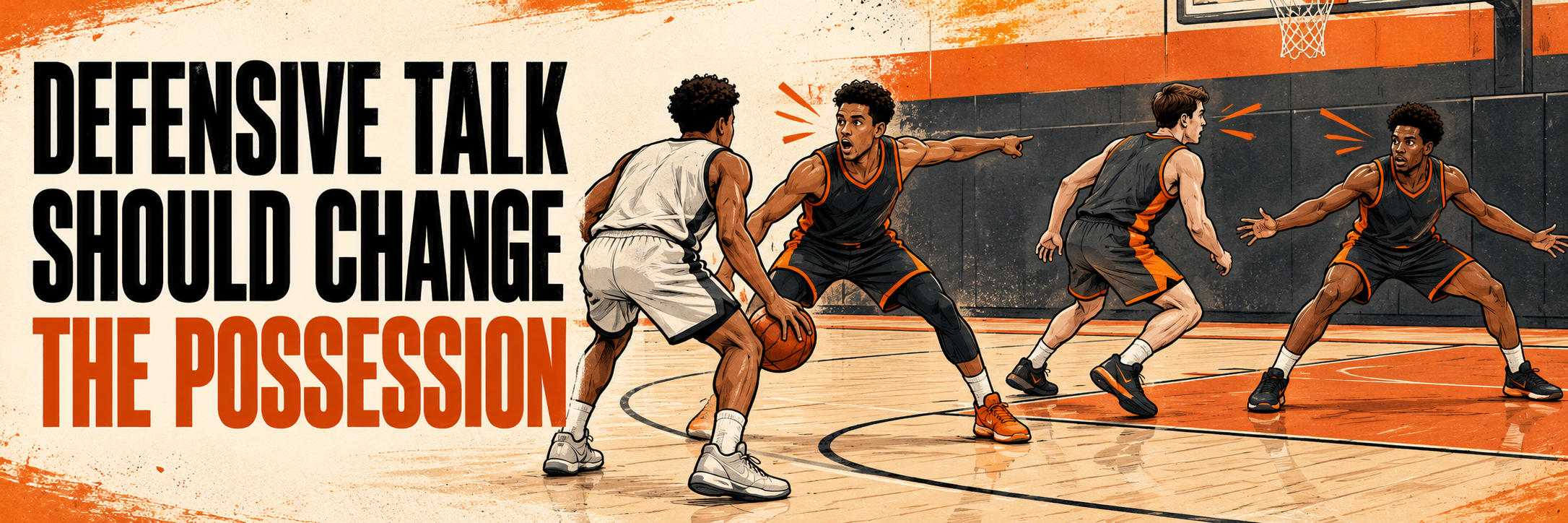
The moment the ball handler picks up the dribble, call “Five.” This is a command for all five defenders to increase pressure together. The defender on the ball closes space legally and makes the next pass difficult. The other four pressure their assignments and deny the available passing options. Nobody gets to watch one teammate work.
Picture the ball trapped on a wing after the dribble has ended. If the nearest receiver is free, pressure on the ball alone achieves very little: one easy pass releases the offense. On “Five,” the whole defense must recognize the same opportunity. Deny the outlet, track the cutter and stay responsible for the basket. Coordinated pressure does not mean five players crowding the ball.
There is also a message for the official: “Five” draws attention to the closely guarded situation and reminds the referee to begin the five second count when its conditions are met. Under FIBA Article 27, a player holding a live ball is closely guarded when an opponent actively guards legally within one meter. The player must pass, shoot or dribble within five seconds. After the dribble has ended, starting another dribble is not an option. The call reminds the official; the count depends on the actual guarding conditions. Check your competition’s rules, since this provision is not identical across basketball rule sets.
Shot: finish the defensive possession
“Shot” should trigger a rebounding response, not five pairs of eyes following the flight of the ball. Defenders identify the player they are responsible for, establish legal rebounding position, box out and pursue the ball. The player contesting the shot must also recover into the play. A good defensive possession is not finished simply because the shooter missed.
Screens: one defender warns, another confirms
The defender guarding the screener usually has the useful view and must warn early enough for a teammate to react. The defender affected by the screen calls or confirms the agreed response. If the call arrives after contact, the information is late. If each defender names a different coverage, the conversation has not solved anything.
Teach a small number of consistent responses that fit your defense. For example, in a practice possession where a switch is the agreed coverage, the warning, the switch call and the exchange of assignments must connect. Hearing the word without seeing the exchange is a reason to stop and teach the action again.
Zone and transition: share what others cannot see
In a zone, the player with a clear view of a high post entry or a baseline runner must give that information to the defenders whose attention is elsewhere. A call should help the next defender locate the threat and take responsibility according to the coverage. Do not assume that seeing a cutter yourself means everyone has seen that cutter.
In transition, establish the priorities immediately: the first defender back communicates responsibility for protecting the rim; the second communicates responsibility for stopping the ball. The remaining defenders locate runners and passing threats. Calling the responsibility out helps prevent two players stopping the ball while nobody protects the basket. Keep scanning as the situation changes.
Build the vocabulary before demanding the volume
With very young players, begin with one or two calls, such as “Mine” and “Five,” and make their meaning clear through play. Add “Shot” and screen responses as the group is ready. The progression depends on what players understand and can execute together, not on how many words a coach can put on a board.
Put the language into a live practice
Start with a controlled mirror activity. One player sees the coach’s visual cue and communicates the agreed instruction to a teammate who responds. Ask whether the message arrived early and produced the correct movement. Then move into a shell drill so that the information has to coordinate several defenders instead of one pair.
In four against four, first rehearse ball movement and responsibility calls. Next, allow a drive and a dribble pickup: “Five” must produce pressure on the ball and denial away from it. Add a screen with one agreed coverage. Finish each live possession with a shot, a rebounding response and a clear outcome. Do not reset while the rebound is still available.
When communication breaks down, identify the missing information and replay the situation. In a live game, an agreed extra offensive possession can make defensive silence visible, provided the consequence is appropriate to the group and understood beforehand. Hold players accountable for recognizing and sharing the situation. Reward the coordinated stop, not the loudest player.
Build ownership of the defensive picture
Each player carries part of the defensive picture. A team becomes coordinated when players feel responsible for sharing what they see. Adjust the language to your group and avoid turning the drill into shouting for its own sake.
At the next practice, choose one call and watch the possession immediately after it. Did all five defenders react? Did the ball become harder to pass? Did the screen coverage actually happen? Did the defense finish with the rebound? That is the standard: the words should change what the team does.
FIBA rule reference: Article 27
“Make each day your masterpiece.”